Author: Rachel Ewing

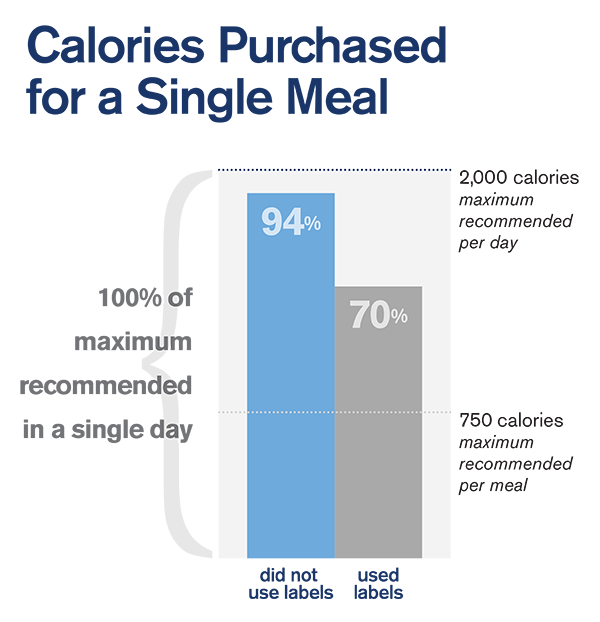
2,000 Calories Per Day are All You Need: A Closer Look at Restaurant Menu Labeling Research

Drexel News Blog Are you reading the fine print? Skipping it could be a bad idea for your health, especially in Philadelphia and other areas where that fine print contains important information: The city’s chain restaurants are required to post information about calories, fat and … Continue reading 2,000 Calories Per Day are All You Need: A Closer Look at Restaurant Menu Labeling Research

Drexel Scientist Studies Hurricane Sandy Impact on NJ Coastal Wetlands One Year Later

Originally posted in EXEL Magazine and updated version below on DrexelNow.

Hurricane Sandy landed right on top of Dr. Tracy Quirk’s wetland monitoring stations – but it wasn’t all bad news.

Quirk, an assistant professor in the Department of Biodiversity, Earth and Environmental Science at Drexel University, had been performing wetland research for several years at monitoring sites in Barnegat and Delaware Bays in New Jersey. Recording devices installed at these sites continuously measured water level and salinity for a wide range of wetland studies at Drexel and the Academy of Natural Sciences of Drexel University.

As Sandy hit and water levels rose, those measurements continued.

“We have continuous data on how long these areas were flooded and how high the water rose at these sites,” said Quirk.

It was a stroke of good luck to have captured detailed measurements during a storm of this rare magnitude. Quirk recognized that the data could provide new answers to the questions she had been investigating about how wetland ecosystems sustain themselves and function. Now she could also learn how marshes responded to the severe disturbance effect of the storm.

“The prospect of future storms of this magnitude suggests that we will need to understand their effects on ecosystem dynamics as part of the ‘new normal,’” Quirk said.

In February she began working on an intensive year-long project, funded by the National Science Foundation, to evaluate ecosystem processes in New Jersey’s salt marshes before, during, and for a year following Hurricane Sandy. Quirk is beginning to analyze findings from the study now.

Good News/Bad News: Coastal Marshes Protective from Worse Flooding, But Findings Suggest They’re Diminishing and Sinking

There was some good news from the marshes: Although some water-level recorders were over-topped and stopped recording (making it difficult to use direct measures of the water height), there was evidence of marsh swelling during the storm. That swelling is an indication of marshes’ ability to absorb some of the storm surge – which, in hard-hit urban areas, had resulted in high water marks up to seven feet during Hurricane Sandy. Quirk points out that resilient, healthy wetlands near coastal areas have a key role in protecting local communities from hurricane-induced storm surges and flooding.

“Imagine having a marsh in front of your house instead of concrete,” Quirk said. “Paved areas make flooding worse because water has nowhere to go.”

Dr. Tracy Quirk uses a meter stick and a Surface Elevation Table (SET) to measure relative sediment elevation change in a salt marsh in Barnegat Bay, N.J.

Dr. Tracy Quirk uses a meter stick and a Surface Elevation Table (SET) to measure relative sediment elevation change in a salt marsh in Barnegat Bay, N.J.

In her post-Sandy research, Quirk was interested in finding out whether the storm affected how the marshes sustain themselves. The disturbance of an intense storm could alter the delicate equilibrium between flooding, vegetation growth and sediment deposits in wetland ecosystems – either temporarily or long-term.

That’s where the bad news comes in. As she works through the data analysis this fall, Quirk said she hasn’t found much sign of sediment deposits, before or after the hurricane struck. Sandy had the potential to deposit a lot of sediments, fast, which would have been good for building up wetlands. Hurricane Irene in 2011 had been associated with a bump up in wetland accretion by several millimeters at a number of locations in the region – a bonus growth equivalent to the amount that typically accrues in an entire year.

“Sediment-limited systems like coastal lagoon marshes largely depend on deposition by storms to vertically adjust elevation, so they don’t sink relative to sea level,” Quirk said. “In places where we have ongoing monitoring, the evidence suggests that some sites are subsiding – sinking below the surface – rather than increasing elevation at a rate similar to local sea level rise. Surface deposition would be a good thing for these marshes.”

Any number of reasons could explain why those hoped-for sediment deposits didn’t materialize, she said. Maybe the unusually high tide during Hurricane Sandy caused less suspension of sediments in the storm-surge waters. Or maybe the storm water did carry sediments and plant debris, but dropped them on the barrier island or inland along the tree line and not at her sampling sites in the marsh interior.

Essential to Protect Coastal Marshes from Subsiding into Water

Whatever the reason, Quirk’s findings point to cause for continued concern over the coastal marshes’ future.

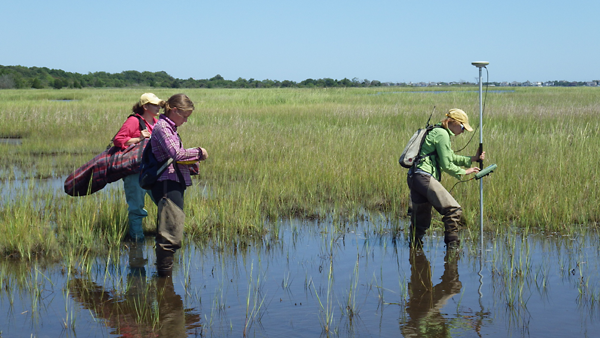
Scientists working with Dr. Tracy Quirk use Real Time Kinematic (RTK) satellite navigation with GPS technology to determine marsh elevation in Barnegat Bay, N.J.

Scientists working with Dr. Tracy Quirk use Real Time Kinematic (RTK) satellite navigation with GPS technology to determine marsh elevation in Barnegat Bay, N.J.

“These salt marshes provide a number of extremely valuable ecosystem services and benefits to society,” she said. Storm surge protection is just one of these. Coastal marshes also provide excellent habitat for commercially and recreationally important fish and shellfish, especially as a nursery ground for these animals. They’re also important for storing, transforming and removing nutrients that can be harmful to the aquatic ecosystems.

The areas of tidal wetlands remaining in New Jersey have been sharply reduced in proportion to the past, with surrounding areas built up with bulkheads and other development – making the remaining wetlands all the more crucial to protect because they cannot shift inland.

“With accelerating sea level rise, it is unknown how many of these marshes are going to be able to keep up because they are dependent on plant growth, which is a slow process,” Quirk said.

“Since 2010, the northern area of Barnegat Bay and the marsh on the bayside of the barrier island at Island Beach State Park is converting before our eyes from marsh to open water.”

– See more at: http://drexel.edu/now/archive/2013/October/Hurricane-Sandy-Marsh-Impacts-One-Year-Later/

Study Shows Longline Fishery in Costa Rica Kills Thousands of Sea Turtles and Sharks

Originally posted on DrexelNow.

The second-most-common catch on Costa Rica’s longline fisheries in the last decade was not a commercial fish species. It was olive ridley sea turtles. These lines also caught more green turtles than most species of fish.

These findings and more, reported in a new study in the Journal of Experimental Marine Biology and Ecology, indicate that the Costa Rican longline fishery represents a major threat to the survival of eastern Pacific populations of sea turtles as well as sharks.

The researchers argue that time and area closures for the fisheries are essential to protect these animals as well as to maintain the health of the commercial fishery.

The research was conducted by a team from Drexel University, the Costa Rican non-profit conservation organization Pretoma and a U.S. non-profit working in Costa Rica, The Leatherback Trust.

The researchers used data from scientific observers on longline fishing boats who recorded every fish and other animal caught by the fishermen from 1999 to 2010 and the locations of the captures and fishing efforts. Those data provided the basis for a mathematical analysis of the fishery resulting in maps of geographic locations and estimates of the total number of captures of sea turtles in the entire fishery.

Stark threats to sea turtles, including nesting populations

The most commonly targeted fish, mahi mahi, was also the most common species caught in the Costa Rican longline fishery.

But the researchers were surprised by their finding that olive ridley turtles, internationally classified as vulnerable, were the second-most-common species caught.

They estimate that more than 699,000 olive ridley and 23,000 green turtles were caught during the study period (1999 to 2010).

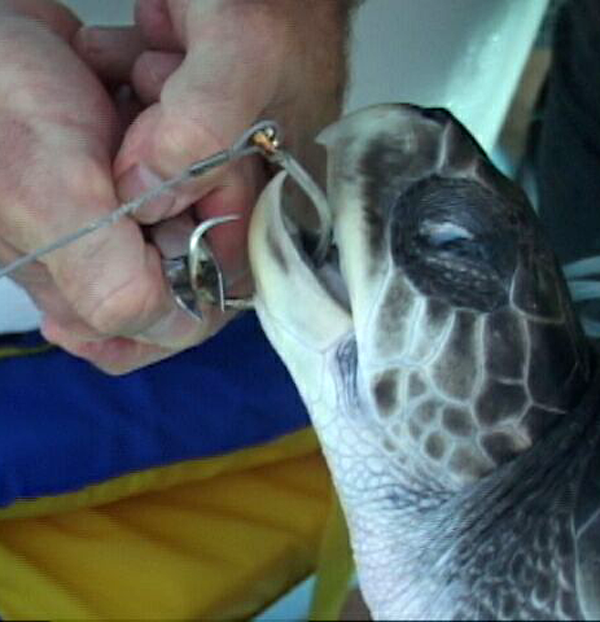
Although about 80 percent of captured sea turtles are released from longlines and survive the experience, at least in the short term, long-term impacts are not yet adequately measured.

“It is common to see sea turtles hooked on longlines along the coast of Guanacaste in Costa Rica. We can set some free but cannot free them all,” said Dr. James Spotila, the Betz chair professor of environmental science in the College of Arts and Sciences at Drexel. “The effect of the rusty hooks may be to give the turtles a good dose of disease. No one knows because no one holds the turtle to see if its gets sick.”

Spotila, a co-author of the study, has been studying sea turtles on the Pacific coast of Costa Rica with colleagues and Drexel students, for 23 years.

The researchers also noted that even a few deaths of reproductive females may have a significant toll—particularly  when longline operations are held in shallow waters of the continental shelf close to nesting beaches.  They reported that declines in olive ridley nesting populations in Ostional, where massive synchronous nesting occurs, were associated with these captures.

Catching more and smaller fish signals an unsustainable fishery, sharks at particular risk

In addition to mahi mahi, other species targeted in the Costa Rican longline fishery were tunas, sharks and marlins.

The researchers observed that longlines caught large numbers of mahi mahi, silky sharks, stingrays, sailfish and yellowfin tuna.

But the fishing patterns showed that shark populations have declined in numbers and sharks have become smaller over 11 years.  Adult sharks were generally small, and juvenile sharks alarmingly abundant, suggesting that some shark species were being overfished: Overall, only 14.6 percent of the abundant silky sharks observed during the study period were sexually mature.  In 2010, the last year of the study, average fork length of silky sharks was 97 cm, far below the observed 144 cm average for mature adults. These decreases in size of silky sharks through time indicated a reduction in relative numbers of adults in the population.

Additionally, many small blacktip sharks were captured in an area near the Osa Peninsula, indicating that fishing was occurring at a nursery ground for that species.

The small size of adult sharks and large numbers of juveniles captured suggest that species are being overfished.

In addition to these indicators of overfishing of sharks, the researchers warned of broader uncertainty about the health of the fishery. They said that capture of large numbers of mahi-mahi does not guarantee that that population is sustainable because the available data can not determine if mahi mahi will remain abundant or decline.

Based on these findings, the researchers caution that that populations of fish affected by the Costa Rican longline fishery may be in danger of collapse and that there are insufficient scientific data to predict whether and when such a collapse will occur and in what species.

How to manage the fishery and save the turtles

About 80 percent of captured turtles are released and survive in the short term, but long-term effects of being caught on fishing hooks are unknown.

To better manage the fishery and protect the threatened and endangered species of sea turtles in Costa Rica, the researchers argue that policymakers in Costa Rica must enforce time and area closures for longline fishing.

They criticize both the fishing industry and INCOPESCA, the fisheries management agency of the government, for failing to recognize that the fishery is unsustainable and failing to enforce existing fisheries laws, such as those against landing of shark fins and harming of sea turtles.

“INCOPESCA has failed to adequately study and regulate the fishery in Costa Rica for many years. It does not even enforce national laws. Board members have serious conflicts of interest because they are commercial fishermen,” said Randall Arauz, president of Pretoma and a world recognized leader in marine conservation. “Until INCOPESCA is reformed in such a way that the Board of Directors is eliminated and its mission is to defend the public interest, neither the fish nor the turtles will be safe.”

Arauz, a co-author of the study, has been studying sea turtles and fisheries in Costa Rica for more than 30 years. He directed the at sea observer program that collected the data on longline boats that were the basis for this study.

Aurauz and Spotila argue for the need to establish well-enforced marine protected areas where both turtles and fish are safe from longlines. They also recommend targeted seasonal closures to longline fishing in coastal waters close to the main turtle nesting beaches when and where sea turtle interactions with the fishery are highest.

They further recommend a general seasonal longline fishery closure for 5 months, from June to November, which can shift, according to the seasonal abundance of mahi mahi.

To enforce these recommendations and provide needed data to manage the fishery, they recommend placing observers on at least half of longline boats, as was done in Chile. Education of local artisanal fishermen would improve their fishing techniques and encourage them to release sea turtles unharmed.

“There is still time to save both the fishery and the turtles if action is taken soon,” Arauz said.

In pursuit of such action, Pretoma and The Leatherback Trust are providing leadership for a coalition of environmental groups in Costa Rica who have united for a special marine conservation initiative called “Front for Our Oceans” (http://www.salvemosnuestrosmares.com/).

For fish and turtle populations to recover successfully, Spotila, who is also chairman of the board of The Leatherback Trust, said, “the challenge is to collect good data on the fishery, establish protected areas of refuge for the animals and to encourage or force INCOPESCA to enforce the laws that have been already passed by the national legislature. What is being done up until now obviously is not working.”

– See more at: http://drexel.edu/now/archive/2013/October/Costa-Rica-Longline-Fishery-Threatens-Sea-Turtles-Sharks/#sthash.lxhf3KK1.dpuf

11th Street Health Center Dedicates A Healing Home Mural in North Philadelphia

Participants in the Porch Light Program have spent the year creating art together at Drexel’s 11th Street Family Health Services, finding fellowship and healing through art. Photo by Lynn Johnson

Originally posted on DrexelNow.

Some people may not consider painting a picture a traditional component of health care. To take that notion further, some may not consider murals an important part of a healthy community. But, despite those expectations, dedicated groups of people across Philadelphia are coming together to help individuals be healthier and to make their communities stronger, through creating public art.

Nearly thirty patients at 11th Street Family Health Services of Drexel University (11th Street) and many more members of their community have become one of these inspiring groups. They have spent the last year together pointing their paintbrushes toward that vision at weekly sessions of the Porch Light Program.

On October 16 at 12:30 p.m., the community will gather at 11th Street to dedicate and celebrate their artwork entitled “A Healing Home.”

“A Healing Home” speaks to universal themes of health, home and nature. The artwork reflects the creativity and effort of community members, 11th Street staff and service recipients and artist Ben Volta.

Together over the course of a year, this group collaboratively envisioned, drew and painted this set of murals to be installed outside the neighborhood K-8 school, Spring Garden School, as well as new glass-etched drawings of medicinal plants on the windows of the 11th Street health center building.

“Creative arts therapies are behavioral health services that we’ve offered to patients at 11th Street for years, as part of our commitment to holistic, integrated care,” said Dr. Patricia Gerrity, a professor and associate dean of Drexel’s College of Nursing and Health Professions, who directs the center. “We chose to partner with the Mural Arts Porch Light Program last year because we also believe in what they are doing to connect art to community and public health.”

Close-up of a woman's hand, painting as part of a healing-focused effort at Drexel's 11th Street health center. Photo by Lynn Johnson

Photo by Lynn Johnson

Porch Light, a project of the City of Philadelphia Mural Arts Program and Department of Behavioral Health and Intellectual disAbility Services, situates art and human connection at the heart of recovery and healing in Philadelphia neighborhoods.

Drexel’s nurse-managed 11th Street health center became one of several health agencies around the city creating a unique piece of public art for its neighborhood through Porch Light in the 2012-13 service year. Lindsay M. Edwards, the director of creative arts therapies at 11th Street, worked with Porch Light staff as well as artist Volta to bring the collaborative art-making process to 11th Street patients.

“As I start drawing, I start setting myself free,” Porch Light participant Ethel Wells said of the experience during a Porch Light gallery exhibition in March. Wells, who did not have much prior interest in art and is quiet and reserved in a group, found relaxation and community by creating art together with the group of 11th Street patients at regular Porch Light sessions.

In addition to the regular weekly sessions for a core group of participants, more patients and community members from 11th Street contributed to the mural artwork during Open Studio days that occurred monthly at first, and up to three full days per week in the 11th Street community room as the murals neared completion.

Artist Ben Volta interacts with participants in the Porch Light program at Drexel's 11th Street health center. Photo by Lynn Johnson

Photo by Lynn Johnson

“This process cultivates relationships and connections not only among the individuals that are engaged, but also in the larger community. To install the completed artwork outside such an important landmark in the community, the Spring Garden School, is something we’re thrilled about,” said Sara Ansell, director of the Porch Light Program. “The point of the artwork created with Porch Light participants is to have it be experienced and understood by the larger community. We are so grateful to have the support of both Drexel University and the Philadelphia School District in helping us forge the connections between the individual community members who created the art and the broader public who will see it every day.”

Upon the dedication of the mural “A Healing Home,” patients at 11th Street will begin a second year of the Porch Light creative process for a new piece of collaborative, healing-focused public art.

– See more at: http://drexel.edu/now/archive/2013/October/11th-Street-Dedicates-A-Healing-Home-Mural/

New Mobile App and Talk Therapies for Binge Eating Disorder

Originally posted on DrexelNow.

Two new treatment methods under investigation at Drexel University aim to help people reduce binge-eating behavior.

A smartphone app in development will track users’ individual patterns of eating and binge eating behavior and alert them at times when they are at risk for binge behaviors, among a comprehensive suite of other features.

Another treatment is a new, evidence-based approach to small-group behavioral therapy that will equip patients with psychological tools that may help them adhere to, and benefit from, standard treatments for binge eating disorder.

Binge eating disorder, characterized by periods of eating objectively large amounts of food, is “associated with a great deal of clinical distress,” said Dr. Evan Forman, an associate professor of psychology in Drexel’s College of Arts and Sciences, co-director, with Dr. Meghan Butryn, of the Laboratory for Innovations in Health-Related Behavior Change, where both studies are being conducted.

Binge eating disorder, only recently identified as an official diagnosis in the Diagnostic and Statistical Manual of Mental Disorders, was found to be about twice as common as bulimia nervosa in a large international survey published earlier this week.

People who engage in binge eating behavior may feel ashamed, out of control and isolated because they may not know others with the disorder, or even know they have a clinically recognized disorder.

The most scientifically supported treatment, cognitive behavioral therapy (CBT), leads to remission for only between 50-60 percent of individuals who complete a full course of treatment.

“It could be improved,” Forman said. “These two studies are an attempt to improve treatments for binge eating.”

A Mobile App for Binge Eating Disorder

Among binge eaters, “there is a cycle of sorts – mounting pressure toward a binge episode, with certain triggers that make it more likely that a binge episode will occur,” Forman said. With cognitive behavioral therapy, a clinician helps patients recognize their personal triggers and learn to interrupt them.

Forman’s lab is developing the “TakeControl” mobile phone app to provide a similar help right in the patient’s pocket – and in real time, at the moment the trigger occurs.

In the app, users can record their binge-eating activity and urges, multiple mood states and whether or not they’ve eaten regular meals and taken their prescription medications. As the app learns about an individual’s patterns of binge-eating behavior and their individual triggers, it can prompt the person with a warning alert when their personal risk is high.

“It could be an emotion like rejection, loneliness, sadness or anxiety, or something external such as passing a certain convenience store, or a time of day or night,” said Forman, who is the principal investigator of the project.

When warned that they are at risk for a binge, or at any time of their own choosing, users can follow the app’s customized interventions to help them in the moment when they need it.

TakeControl binge eating app home screen


Users of the “TakeControl” app can choose how much and how little of their personal data to enter to help the app help them. The app also includes learning modules, optional personal goal-setting modules and optional social networking features to connect with others who share this often-isolating disorder.

“Using the data visualization modules, people can chart their behavior patterns over time,” said Stephanie Goldstein, a graduate student in Forman’s lab working on the project. “This shows people the progress they’ve made and reinforces it. Someone could also learn from the charts, for example, how their binges relate to their anxiety.”

TakeControl app mood entry screen

Forman’s research team is developing the app on the Android platform in collaboration with the Applied Informatics Group in Drexel’s College of Computing and Informatics.

“Most users have their smartphone with them upwards of 20 hours a day, so a mobile app can be a very effective way to monitor behaviors that a physician wouldn’t automatically know about,” said Gaurav Naik, a co-investigator on the project from the AIG. “By combining AIG’s knowledge of engineering systems that can learn from data, and the clinical knowledge of our partners in psychology, we can develop an app that we hope can generate successful outcomes.”

The project was one of two winners selected in an internal university-wide competition under the auspices of a Shire Pharmaceuticals-Drexel University Innovation Partnership. In December 2013, each project will be considered by Shire for further expansion and commercialization. If funded, the group expects to also develop a version for iOS.

Future plans for the app include connections with other technologies for automatic personal data tracking, such as smart pill bottles, web-connected scales and activity bands, as well as existing popular diet and fitness-tracking apps.

Users of the app will also have the option to share their data with their therapist or other clinician, either automatically through a clinician’s portal, or by bringing their exported data to a therapy session.

Therapy to Help the Therapy Work Better

“Standard treatment for binge  eating disorder is largely behavioral – in that it tells people what to do,” said Dr. Adrienne Juarascio, a postdoctoral fellow in Forman’s lab who is the principal investigator of the in-person treatment study. “In CBT we ask people to adhere to uncomfortable treatment recommendations, such as eating every three to four hours even when they are concerned about weight gain. Or they might be asked to engage in alternative activities while they are having the urge to binge.

“It can be very difficult to complete these treatment recommendations, no matter how motivated people are.”

Juarascio is now coordinating an experimental treatment program for binge eating disorder that teaches patients psychological strategies to deal with the discomfort associated with traditional treatments.

The 10-session group therapy program integrates the gold-standard cognitive behavioral therapy with another method, acceptance and commitment therapy (ACT) and other third generation acceptance-based behavioral treatments, to help patients learn to tolerate and accept stressful experiences and distressing thoughts, without engaging in disordered behaviors.

“Different people find it uncomfortable for different reasons,” Forman said. “For example, if someone had binged the night before and thought, ‘There’s no way I’m eating breakfast after that,’ the ACT skills are designed to help the person recognize this feeling of being repulsed by food, and proceed to eat breakfast anyway because consistently eating regular meals is healthier in the long run.”

Juarascio previously piloted the approach, combining treatment-as-usual with ACT in the treatment of eating disorders more broadly, as part of her doctoral research at Drexel. In the July 2013 issue of the journal Behavior Modification, she, Forman and other colleagues reported that patients receiving the combined therapy had better outcomes at a six-month follow-up than did those receiving standard treatments.

– See more at: http://drexel.edu/now/archive/2013/September/Binge-Eating-Smartphone-App-Therapy-Studies/


Past Weight Loss an Overlooked Factor in Disordered Eating

Originally posted on DrexelNow.

Dieters and weight loss researchers are familiar with the principle: The more weight you’ve lost, the harder it is to keep it off. A complex and vicious cycle of biological and behavioral factors make it so.

But eating disorder research has largely overlooked this influence, and Dr. Michael Lowe, a professor of psychology at Drexel University, has published a flurry of research studies showing that needs to change.

“The focus of eating disorder research has very much been on the state of patients’ thoughts, beliefs, emotions and personalities,” Lowe said. “And while these mental influences are undoubtedly part of the problem, historically there has been very little focus on how their current and past body weights contribute to their eating disorder.”

Lowe and colleagues’ studies – about a dozen on bulimia nervosa have been published in the past several years – show that having an elevated past body weight, and being at a body weight well below highest past weight, may help cause and perpetuate disordered eating. The latest of Lowe’s studies was just published in The Journal of Abnormal Psychology, the top journal for eating disorder research, and is the team’s first to address this principle in anorexia nervosa.

The findings, Lowe says, show that researchers and clinicians need to start taking into account how a person’s historical and current body weight contribute to disordered eating.

“This fundamentally changes the assumption that the problem is primarily psychological or emotional,” Lowe said.

The new study, led by doctoral student Laura A. Berner, was based on data collected at the Renfrew Center for eating disorders in Philadelphia, where Lowe is also a consultant. The researchers found that the level of eating disorder symptoms, as well as degree of improvement during treatment, depends on how much weight anorexic patients had lost from their previous highest weight (a measure called “weight suppression”), how much they currently weigh and the interaction between the two.

After controlling for patients’ body mass index (BMI, which is a known indicator of disease severity), they found that patients with greater weight suppression had more severe symptoms of anorexia than patients whose low weight was closer to their historical highest weight. Standard measures of disordered eating such as shape concerns, eating concerns, binge eating, depression and menstrual abnormalities were correlated with weight suppression, current BMI, or both.

Lowe said that researchers and clinicians who already use weight or BMI as an absolute measure of eating disorder severity should also consider weight suppression as a relative measure.

These findings also may have important implications for treatment.

“The standards for treating anorexia nervosa are all about ‘how much weight do they need to gain to meet a minimally healthy body weight for their height,’” Lowe said. “What we’ve rarely asked, is ‘what did this patient weigh before she developed anorexia?’”

Lowe said his ongoing research suggests that the answer is that many anorexic patients weighed more than their peers before developing anorexia.

“If the patient’s body somehow ‘remembers’ that past higher weight, then even at the minimally healthy body weight she is still going to be struggling mightily to maintain her weight,” Lowe said. “That perspective is new. It suggests that future treatments might work toward finding a healthier ‘balance point’ between what patients once weighed and what they currently weigh.”

“It is really helpful to have more than one way to look at weight in the eating disorders; we now have evidence that absolute weight and relative weight are both important in predicting difficulties in our work towards full recovery,” said Dr. Susan Ice, vice president and chief medical officer of The Renfrew Center. “And it is immensely satisfying to find that science has discovered that there is physical memory or a kind of ‘wisdom’ in the body.”

Lowe and his research team were recently funded by the National Institute of Mental Health to further investigate the role of these weight-related variables on bulimia nervosa. Individuals with symptoms of bulimia who are interested in participating in this federally funded study may call 215-553-7171 or email TEDS@drexel.edu for additional information.

Another research laboratory at Drexel, the Laboratory for Innovations in Health-Related Behavior Change, is recruiting participants who have experienced binge eating problems but do not engage in compensatory behaviors such as self-induced vomiting or laxative use. One project is investigating a new smartphone app for binge eating and the other is evaluating an in-person treatment. Individuals who are interested in participating in these research studies may call 215-553-7100.

– See more at: http://drexel.edu/now/archive/2013/September/Past-Weight-Loss-an-Overlooked-Factor-in-Eating-Disorders/

Witnesses to Hunger Photo Exhibit Opens Lens on Hunger and Poverty in Camden

“Kids do grow up happy in Camden. I did. I came out fine.” – Photo and voice by Beatrize, a Witness to Hunger

Originally posted on DrexelNow.

The USDA reported last week that more than one in five American children under the age of six lives in a household where caregivers may not have enough money to afford enough food for an active, healthy life. Later this month, the U.S. Census Bureau is due to release its latest reports on the nation’s poverty rate.

Such statistics about poverty and food insecurity are arresting, but all too often, they are hard to understand in the context of real people’s lives and communities.

In Camden, N.J. – a city often proclaimed one of America’s most impoverished and most dangerous – ten mothers and grandmothers want to show, through personal and powerful photographs, what these statistics really mean and what can be done about them.

Through their desire for social change, the women of Camden have opened a lens on hunger, homelessness, health and a broad swath of issues related to poverty. Their photos and interview-based testimony, collected as part of the “Witnesses to Hunger” project based at the Center for Hunger-Free Communities at Drexel University School of Public Health, will be on public display in Camden for the first time this month.

Gallery Eleven One (339 N. Front Street, Suite B, Camden, N.J.) will feature the free, public exhibit from Sept. 18 to 21. (Wednesday, 1:30-7 p.m.; Thursday and Friday, 5 to 9 p.m.; Saturday noon to 5 p.m.)

The public exhibit kicks off with a panel discussion about housing and hunger, at nearby Rutgers Camden on Wednesday, Sept. 18 at noon. Attendees may register at https://witnesseshousingpanel.eventbrite.com/.

Many of the Witnesses will be in attendance to discuss their photographs and their experiences at an opening reception at the gallery on Thursday, Sept. 19, from 5 to 9 p.m. Attendees may RSVP for the free reception at https://camdenwitnessesexhibit.eventbrite.com/.

By photographing their lives and families, Witnesses frame their own perspectives of what it will take to address poverty and hunger in their community and across the country. Camden’s Witnesses to Hunger photographs provide unique and searing insight on a wide range of topics from their every-day experiences—including food and hunger; housing and homelessness; experiences with the welfare system; employment and education; and violence and safety.

Camden’s ten Witnesses to Hunger began taking photos this January and debuted their photos in June at a private exhibit held at the world headquarters of the Campbell’s Soup Company.

“Witnesses to Hunger” was developed in 2008 by Dr. Mariana Chilton, an associate professor and director of the Center for Hunger-Free Communities at Drexel, as a community-based participatory action research project to document the complex issues surrounding food insecurity, poverty and children’s health. Chilton formed this project to ensure that parents and caregivers of young children who have experienced poverty and hunger first-hand are participating in the national dialogue on child poverty and hunger. The Witnesses – now hailing from sites in Philadelphia, across Pennsylvania, Boston, Baltimore and Camden —  use digital cameras to frame the issues most important to them and their children. They use photographs and testimony to inform policymakers to make changes in their communities.

For more information about the Camden Witnesses to Hunger, view selected biographies and photos at http://www.centerforhungerfreecommunities.org/our-projects/witnesses-hunger/meet-the-real-experts.

– See more at: http://drexel.edu/now/archive/2013/September/Witnesses-to-Hunger-Camden-Exhibit/