Author: Rachel Ewing

Campaign Celebrates Food Stamps’ Half Century Protecting Public Health

Originally posted on DrexelNow.

Fifty years ago, American lawmakers and the public found the presence of hunger in U.S. communities so appalling that people came together and legislators reached across the aisle to do something about it: they passed the Food Stamp Act of 1964, providing federally funded nutritional assistance to individuals and families in need.

Although food stamps have become a hot-button political issue, public health experts and anti-poverty advocates have long held that the program, now known as SNAP (the Supplemental Nutrition Assistance Program), is a tremendous public good.

“Our research has shown that SNAP is one of the single most effective pieces of legislation in protecting the health of young children and promoting their cognitive, emotional and social development,” said Mariana Chilton, PhD, an associate professor and director of the Center for Hunger-Free Communities at Drexel University.

Now, a nationwide campaign, initiated by Chilton and her colleagues at Drexel’s School of Public Health, will celebrate 50 years of food stamps’ health benefits and support for working parents–a timely reminder near the one-year anniversary of cuts to SNAP on Nov. 1, 2013. Those cuts reduced benefits for every family participating in the program.

The campaign invites everyone to share photos, experiences, thoughts, questions – anything they would like to say about SNAP– using the hashtag #snap4SNAP, on social media on Oct. 30 from 2-4 p.m. EDT and in the days and weeks to follow. Contributors are invited to share their perspectives on how SNAP helps families, facts about SNAP or thoughts about the impact of cuts to SNAP – with photos when possible.

More than 50 organizations have committed to participate in #snap4SNAP. The hashtag and campaign play on the word “snap” also being used for the action of taking a photo – inspired by the groundbreaking “Witnesses to Hunger” program based at Drexel, which, since 2008, has engaged low-income parents in sharing photos of their experiences with hunger and poverty to bring their first-hand experiences and knowledge into the public conversation. Participants in Witnesses to Hunger will also be actively contributing to the #snap4SNAP conversation on Oct. 30.

“The #snap4SNAP campaign aims to illuminate the real life experiences of SNAP recipients and give people a platform to talk about the program,” said Chilton. “By using social media, we can bring a dose of reality to the conversation around hunger.”

For more information and frequently asked questions about the #snap4SNAP campaign, and to see a list of some of the participating organizations, visit Drexel’s Center for Hunger-Free Communities website.

– See more at: http://drexel.edu/now/archive/2014/October/snap4SNAP-Celebrates-Food-Stamps/

Psychological Services Center Opens at Drexel, Offering Affordable, Cutting-Edge Care for Philadelphia Region

Originally posted on DrexelNow.

A new center on Drexel University’s campus in the University City section of Philadelphia is now offering high-quality, scientifically informed, affordable psychological services to clients of all ages from the city and surrounding region.

The Drexel Psychological Services Center offers assessments and therapy provided by doctoral students in Drexel’s highly competitive clinical psychology PhD program, who are working as trainees under the supervision of licensed professional faculty from the Department of Psychology in the College of Arts and Sciences.

Drexel will formally celebrate its opening at a ribbon-cutting ceremony on Oct. 2.

“A real advantage of coming to Drexel’s Psychological Services Center is that we offer the newest evidence-based assessments and treatments,” said Jennifer Schwartz, PhD, director of the center. “These services have undergone scientific evaluation to demonstrate that they are effective, and are not always available in community practices.”

Most services at Drexel’s Psychological Services Center are offered on a sliding fee scale and medical insurance is not accepted. Fees are typically set to be manageable for clients and depend on the size and income level of the client’s household. The center welcomes members of the surrounding communities and students at other universities, but encourages full-time Drexel students to continue to use the University’s Counseling Center, free of charge.

The center’s areas of specialty align with those of Drexel’s psychology faculty, including:

  • Mood and anxiety disorders, including evidence-based treatments for stress, depression, anxiety, phobias, trauma, grief, relational issues and identity concerns
  • Disorders of eating, including anorexia, bulimia, compulsive overeating and weight management, bariatric surgery evaluations
  • Behavioral medicine, including evidence-based approaches to stress management, sleep disorders, concerns related to reproductive health and living with chronic pain or other physical health problems
  • Clinical neuropsychological assessments including  services for attention and executive functioning, learning and memory, concussion and mild traumatic brain injury and other neurological injuries and diseases
  • Child and adolescent services including evidence-based treatments and assessments for behavioral concerns such as ADHD, mood problems, social skills challenges, academic and school challenges, health risk behaviors and more
  • Forensic psychological assessments, including assessments of intellectual ability and adaptive function for justice-involved individuals

As a training facility for Drexel’s doctoral students, the Psychological Services Center offers many advantages to clients as well as to the trainee clinicians. Clinicians carry small caseloads and are able to devote a great deal of attention to each client. Clinicians are closely monitored by, and meet regularly with, their experienced supervisors to ensure they are delivering the best possible care.

Individuals interested in seeking services at Drexel’s Psychological Services Center should call 215.553.7128 to schedule a no-cost intake appointment to determine if the center is a good fit.

For more information about the Psychological Services Center, visit the clinic website.

– See more at: http://drexel.edu/now/archive/2014/September/Psychological-Services-Center-Opens/

A World-Class Fossil Dig, a One-of-a-Kind Community Event

Originally posted on DrexelNow.

In the course of a single day, more than a thousand residents and visitors to southern New Jersey will dig into – literally – the process of paleontology and discovery at Mantua Township’s Community Fossil Dig Day. They will have the opportunity to dig their own fossils and to learn from the Drexel University paleontologist and students who conduct globally significant scientific research at the site at the sold-out event on Sept. 27 – the third annual event and the biggest yet.

“Big” is nothing new for Kenneth Lacovara, PhD, the on-site paleontologist at the Mantua Township, N.J. Inversand fossil dig site. Lacovara, an associate professor in Drexel’s College of Arts and Sciences, made international headlines earlier this month with the announcement of the new supermassive dinosaur species Dreadnoughtus schrani that he and collaborators unearthed in Argentina between 2005 and 2009.

Closer to home, Lacovara and Drexel students are making equally exciting discoveries as they dig fossils year-round at Inversand.

“Dinosaur paleontology began in New Jersey,” Lacovara said. “The world’s first discovered dinosaur was in Haddonfield, N.J. and was studied at what is now the Academy of Natural Sciences of Drexel University.”

Mantua Township’s Inversand Quarry has been a fossil dig for generations of scientists continuously since 1926, when mining operations and paleontological research by Academy scientists both began there. Today, the Inversand quarry is the last remaining marl pit on the East Coast that remains an active mining operation for manganese greensand – continuously pumping water from what would otherwise be a lake, in the process keeping the fossil layer exposed and available for ongoing discovery.

“This is the best site for Cretaceous-age fossil exposures east of the Mississippi River,” Lacovara said. “Here we find exquisite fossils of marine animals that lived here when this was a shallow coastal environment, including mosasaurs, which were essentially giant marine Komodo dragons, sea turtles, crocodiles and more.”

Even more remarkable, in recent years Lacovara and Drexel students have been carefully documenting the evidence of a mass die-off of the animals that once lived here in pursuit of a provocative question: Is this fossil bonebed linked to the extinction that wiped out the dinosaurs 65 million years ago?

“We don’t know,” said Lacovara, “but that is the hypothesis that we are testing by examining the fossils, the sediments and the chemistry.” If this idea is validated by the evidence, which could take years, Lacovara noted, the Inversand Quarry could be a window into this pivotal moment in time like no other.

Community Fossil Dig Day

For the community, having such a rich fossil site within 20 minutes of Philadelphia and conveniently accessible behind a New Jersey shopping plaza is a rare and special opportunity. Mantua Township officials and the Inversand Company, which owns and operates the site, have teamed up with Lacovara to share the scientific discovery process with the community. The annual Community Fossil Dig Day began in October 2012 through this partnership.

Children and teens dig for fossils.
Attendees of all ages at the annual Community Fossil Dig Day have the opportunity to dig for their own fossils and often may take home what they find.

On Dig Day, attendees of all ages learn about the site’s history and scientific importance, then observe the live excavation area where Drexel students are unearthing scientifically significant, articulated vertebrate fossils such as sea turtles and marine reptiles and crocodiles. Next, attendees get to dig into the muddy, wet sand in their own designated digging areas. Attendees often find marine animal remains from 65 million years ago, including fossilized shark teeth, shark feces and clams – and in most cases they can take home what they find.

“I still have goosebumps thinking of what I saw there,” one resident wrote after the first Community Dig Day, which drew explorers from the local community and from as far as New York and Maryland. “Thank you for the experience of a lifetime.”

Following Lacovara’s recent Dreadnoughtus dinosaur announcement, the 2014 Dig Day on Sept. 27 will also feature a special celebration of Dreadnoughtus and the extraordinary excitement of a major dinosaur discovery made by South Jersey’s own on-site paleontologist at Inversand.

Also on hand to help on Saturday will be volunteers from the Delaware Valley Paleontological Society, the Delaware Valley Earth Science Society, Rowan College at Gloucester County, Rowan University and the University of Pennsylvania. Additionally, dozens of community volunteers will be on-site.

High Demand and Hope for Preservation

The popularity of Dig Day continues to grow, according to Michelle Bruner, Mantua Township Economic Development Coordinator, a primary organizer of the event. This year, the 1,000 registration spaces for the event were filled within two and a half days of opening. More than 400 are on the waiting list and will get priority registration next year.

“We’ve had over 5,000 guests in the three years of this event,” Bruner said. “The response has been overwhelming.”

In addition to the annual Community Dig Day, the Township and Lacovara offer educational opportunities for schools from across the region at Inversand, including hosting school field trips with hands-on science workshops led by Drexel students, as well as offering site tours for various civic organizations.

These types of educational opportunities are only the beginning. The team of partners behind Dig Day is working with other supporters in Gloucester County toward a long-term vision of preserving Inversand as a fossil heritage park in perpetuity. The Township has applied for funding through the New Jersey Green Acres program and continues to raise private donations toward acquiring the land for preservation and development of a fossil park and paleontological education center supporting STEM education.

– See more at: http://drexel.edu/now/archive/2014/September/Community-Fossil-Dig-Day-in-New-Jersey/

Looking Beyond the Numbers: Experts Can Comment on What Poverty Data Mean for U.S. Families

Drexel News Blog Today the U.S. Census Bureau released data on income, poverty and health insurance for 2013.  The data show that poverty continues to impact families and communities throughout the country. Despite the recession coming to an end officially in 2009, many Americans are … Continue reading Looking Beyond the Numbers: Experts Can Comment on What Poverty Data Mean for U.S. Families

A.J. Drexel Autism Institute Receives $3.6 Million Gift to Launch Life Course Outcomes Research Initiatives

Originally posted on DrexelNow.

The A.J. Drexel Autism Institute at Drexel University has received a grant of $3.6 million from an anonymous donor to launch four major initiatives of its Life Course Outcomes research program, focused on understanding and improving quality of life issues for people on the autism spectrum at all ages. This program is led by Autism Institute professor Paul Shattuck, PhD, a nationally recognized expert on these issues.

“Finding ways for people on the autism spectrum to pursue fulfilling lives as full members of the community is vitally important work,” said Drexel University President John A. Fry. “Thanks to this incredibly generous gift, Drexel can help Dr. Shattuck expand his pioneering work in this area and further the A.J. Drexel Autism Institute’s critical mission.”

Four major research initiatives being advanced by the Life Course Outcomes Program include:

  1. Indicators Initiative, assessing community and national indicators of services and outcomes
  2. Promising Practices Initiative, examining innovative approaches to service provision and policies
  3. Research Leadership Initiative, expanding the field of useful research by training additional scholars
  4. Long-Term Knowledge Initiative, doing studies that discover how life unfolds over a long period of time for people on the autism spectrum and their families.

The Autism Institute leadership is actively pursuing additional partnerships for these key initiatives.

“About 500,000 adolescents on the autism spectrum will enter adulthood in the next decade,” said Shattuck, an associate professor at the A.J. Drexel Autism Institute with a secondary appointment in Drexel’s School of Public Health. “We believe people on the autism spectrum are valuable members of our communities. They have roles to play, dreams to achieve and contributions to make. We see an urgent need for research aimed directly at understanding what strategies, beyond clinical interventions, promote positive outcomes and prevent negative ones – both for people on the autism spectrum and the families and communities they are part of.”

Shattuck joined Drexel in 2013 and is one of only a handful of scholars in the world whose work is wholly devoted to answering these kinds of questions. The A.J. Drexel Autism Institute was established in 2012 as the nation’s first autism research center based on a public health science approach.

Drexel’s Life Course Outcomes Program addresses questions about quality of life across the entire lifespan. Are children getting diagnosed and entering services at an early age? What’s holding back more adults on the spectrum from attending college or becoming gainfully employed? What kinds of services do people receive compared to what they need? What’s working and what’s not?

The program’s aims address the needs and challenges recognized by many adults on the autism spectrum as well as by parents of children with autism who anticipate the so-called “services cliff” that occurs when young adults on the spectrum age out of supports that are available to children and adolescents.

Sonia Voynow, a psychotherapist and parent of a teenager with ASD, who leads support groups for parents and grandparents of children on the spectrum, noted “a sense of terror” among parents such as herself when anticipating their kids’ future. “We know that our children are capable of so much when they have the right supports,” Voynow said. “But we don’t know where to find these resources, or if they even exist, particularly as our kids reach adulthood. Drexel’s Autism Institute, by using a systematic and organized approach to focus on what works for these kids, is filling a huge, and growing, need.”

“No approach to autism from a public health perspective could be comprehensive without considering the experiences of individuals and communities across the entire lifespan,” said Craig Newschaffer, PhD, director of the A.J. Drexel Autism Institute and a professor in Drexel’s School of Public Health. “We are grateful to our anonymous donor whose generosity will help Drexel lead the way on research with a lifespan perspective. Dr. Shattuck will answer essential questions for individuals on the spectrum, their families and our communities.”

As the Life Course Outcomes program grows, Shattuck and colleagues at Drexel envision – as described in a recent JAMA Pediatrics editorial an approach that is centered on innovation and investment. Their aims include learning from innovations already underway in communities; measuring systematically and repeatedly to quantify societal impacts over time; planning large, long-term life-course studies for autism; and increasing the number of scholars pursuing this line of work.

“Ultimately, we need to know if the billions spent to move the needle on life outcomes like employment, health, community contribution, and social participation are having a measurable impact,” said Shattuck. “This gift positions the A.J. Drexel Autism Institute to lead the way in figuring out how to strengthen the connection between efforts and outcomes so we know what’s working for whom.”

For More Information

To learn more about research at the A.J. Drexel Autism Institute, see the special report in Drexel University’s research magazine, EXEL: Exploring the Spectrum.

To learn more about the A.J. Drexel Autism Institute, visit the institute’s website or follow on Facebook or Twitter.

– See more at: http://drexel.edu/now/archive/2014/September/Autism-Life-Course-Research/

Dreadnoughtus schrani: Frequently Asked Questions on the Super-Massive Dinosaur

Drexel News Blog An artist’s rendering of the dinosaur Dreadnoughtus schrani in life. Dreadnoughtus had a 37-foot-long neck, 30-foot tail, and weighed an estimated 65 tons, making it the most massive land animal whose size can be accurately calculated. Credit: Jennifer Hall In a scientific … Continue reading Dreadnoughtus schrani: Frequently Asked Questions on the Super-Massive Dinosaur

Digging Deeper into Dreadnoughtus: Dinosaur Interview with Ken Lacovara

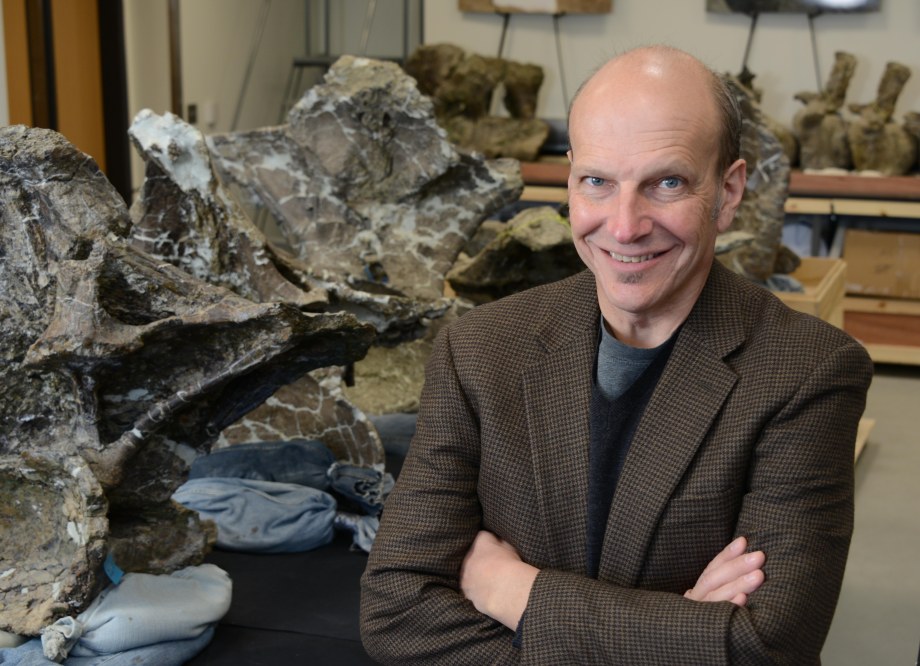
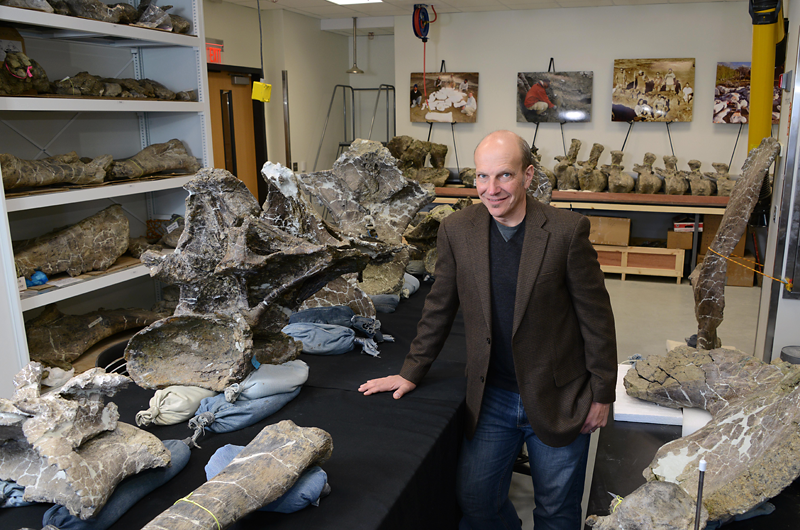
Drexel News Blog Kenneth Lacovara, PhD with Dreadnoughtus schrani fossils. A team led by Drexel University’s Kenneth Lacovara, PhD announced a major new dinosaur discovery with a paper published in the journal Scientific Reports on Sept. 4, 2014. The dinosaur is BIG. So big that … Continue reading Digging Deeper into Dreadnoughtus: Dinosaur Interview with Ken Lacovara

Drexel Team Unveils Dreadnoughtus: A Gigantic, Exceptionally Complete Sauropod Dinosaur

Originally posted on DrexelNow.

Scientists have discovered and described a new supermassive dinosaur species with the most complete skeleton ever found of its type. At 85 feet (26 m) long and weighing about 65 tons (59,300 kg) in life, Dreadnoughtus schrani is the largest land animal for which a body mass can be accurately calculated. Its skeleton is exceptionally complete, with over 70 percent of the bones, excluding the head, represented. Because all previously discovered supermassive dinosaurs are known only from relatively fragmentary remains, Dreadnoughtus offers an unprecedented window into the anatomy and biomechanics of the largest animals to ever walk the Earth.

Dreadnoughtus schrani was astoundingly huge,” said Kenneth Lacovara, PhD, an associate professor in Drexel University’s College of Arts and Sciences, who discovered the Dreadnoughtus fossil skeleton in southern Patagonia in Argentina and led the excavation and analysis. “It weighed as much as a dozen African elephants or more than seven T. rex. Shockingly, skeletal evidence shows that when this 65-ton specimen died, it was not yet full grown. It is by far the best example we have of any of the most giant creatures to ever walk the planet.”

Lacovara and colleagues published the detailed description of their discovery, defining the genus and species Dreadnoughtus schrani, in the journal Scientific Reports from the Nature Publishing Group today. The new dinosaur belongs to a group of large plant eaters known as titanosaurs. The fossil was unearthed over four field seasons from 2005 through 2009 by Lacovara and a team including Lucio M. Ibiricu, PhD, of the Centro Nacional Patagonico in Chubut, Argentina, Carnegie Museum of Natural History’s Matthew Lamanna, PhD, and Jason Poole of the Academy of Natural Sciences of Drexel University, as well as many current and former Drexel students and other collaborators.

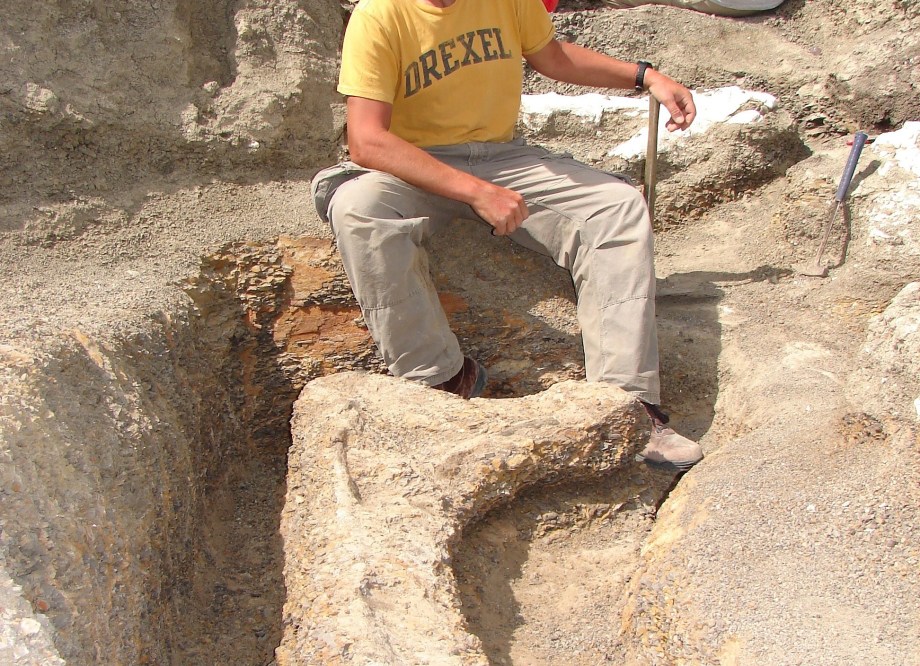
Over 100 elements of the Dreadnoughtus skeleton are represented from the type specimen, including most of the vertebrae from the 30-foot-long tail, a neck vertebra with a diameter of over a yard, scapula, numerous ribs, toes, a claw, a small section of jaw and a single tooth, and, most notably for calculating the animal’s mass, nearly all the bones from both forelimbs and hindlimbs including a femur over 6 feet tall and a humerus. A smaller individual with a less-complete skeleton was also unearthed at the site.

The ‘gold standard’ for calculating the mass of quadrupeds (four-legged animals) is based on measurements taken from the femur (thigh bone) and humerus (upper arm bone). Because the Dreadnoughtus type specimen includes both these bones, its weight can be estimated with confidence. Prior to the description of the 65-ton Dreadnoughtus schrani specimen, another Patagonian giant, Elaltitan, held the title of dinosaur with the greatest calculable weight at 47 tons, based on a recent study.

Overall, the Dreadnoughtus schrani type specimen’s bones represent approximately 45.3 percent of the dinosaur’s total skeleton, or up to 70.4 percent of the types of bones in its body, excluding the skull bones. This is far more complete than all previously discovered giant titanosaurian dinosaurs.

“Titanosaurs are a remarkable group of dinosaurs, with species ranging from the weight of a cow to the weight of a sperm whale or more. But the biggest titanosaurs have remained a mystery, because, in almost all cases, their fossils are very incomplete,” said Matthew Lamanna.

For example, Argentinosaurus was of a comparable and perhaps greater mass than Dreadnoughtus, but is known from only a half dozen vertebrae in its mid-back, a shinbone and a few other fragmentary pieces; because the specimen lacks upper limb bones, there is no reliable method to calculate a definitive mass of Argentinosaurus. Futalognkosaurus was the most complete extremely massive titanosaur known prior to Dreadnoughtus, but that specimen lacks most limb bones, a tail and any part of its skull.

To better visualize the skeletal structure of Dreadnoughtus, Lacovara’s team digitally scanned all of the bones from both dinosaur specimens. They have made a “virtual mount” of the skeleton that is now publicly available for download from the paper’s open-access online supplement as a three-dimensional digital reconstruction.

“This has the advantage that it doesn’t take physical space,” Lacovara said. “These images can be ported around the world to other scientists and museums. The fidelity is perfect. It doesn’t decay over time like bones do in a collection.”

“Digital modeling is the wave of the future. It’s only going to become more common in paleontology, especially for studies of giant dinosaurs such as Dreadnoughtus, where a single bone can weigh hundreds of pounds,” said Lamanna.

The 3D laser scans of Dreadnoughtus show the deep, exquisitely preserved muscle attachment scars that can provide a wealth of information about the function and force of muscles that the animal had and where they attached to the skeleton – information that is lacking in many sauropods. Efforts to understand this dinosaur’s body structure, growth rate, and biomechanics are ongoing areas of research within Lacovara’s lab.

A Dinosaur that Feared Nothing

Illustration: Jennifer Hall

“With a body the size of a house, the weight of a herd of elephants, and a weaponized tail, Dreadnoughtus would have feared nothing,” Lacovara said. “That evokes to me a class of turn-of-the-last century battleships called the dreadnoughts, which were huge, thickly clad and virtually impervious.”

As a result, Lacovara chose the name “Dreadnoughtus,” meaning “fears nothing.” “I think it’s time the herbivores get their due for being the toughest creatures in an environment,” he said. The species name, “schrani,” was chosen in honor of American entrepreneur Adam Schran, who provided support for the research.

To grow as large as Dreadnoughtus, a dinosaur would have to eat massive quantities of plants. “Imagine a life-long obsession with eating,” Lacovara said, describing the potential lifestyle of Dreadnoughtus, which lived approximately 77 million years ago in a temperate forest at the southern tip of South America.

“Every day is about taking in enough calories to nourish this house-sized body. I imagine their day consists largely of standing in one place,” Lacovara said. “You have this 37-foot-long neck balanced by a 30-foot-long tail in the back. Without moving your legs, you have access to a giant feeding envelope of trees and fern leaves. You spend an hour or so clearing out this patch that has thousands of calories in it, and then you take three steps over to the right and spend the next hour clearing out that patch.”

An adult Dreadnoughtus was likely too large to fear any predators, but it would have still been a target for scavengers after dying of natural causes or environmental disasters. Lacovara’s team discovered a few teeth from theropods – smaller predatory and scavenging dinosaurs– among the Dreadnoughtus fossils. However, the completeness and articulated nature of the two skeletons are evidence that these individuals were buried in sediments rapidly before their bodies fully decomposed. Based on the sedimentary deposits at the site, Lacovara said “these two animals were buried quickly after a river flooded and broke through its natural levee, turning the ground into something like quicksand. The rapid and deep burial of the Dreadnoughtus schrani type specimen accounts for its extraordinary completeness. Its misfortune was our luck.”

Further Information and Resources

For a full suite of resources, including multimedia content available for use by the news media, please see the collection of links on the Dreadnoughtus Media Resource Page.

Link to paper (on and after Sept. 4, 2014): http://dx.doi.org/10.1038/srep06196

Primary collaborators on the study with Lacovara were Matthew C. Lamanna, PhD of the Carnegie Museum of Natural History in Pittsburgh and Lucio M. Ibiricu, PhD of the Centro Nacional Patagonico in Chubut, Argentina, who began working with Lacovara as an undergraduate volunteer during the Dreadnoughtus excavation and went on to earn his doctoral degree at Drexel University. Lamanna was first author on a recent paper describing the dinosaur Anzu wyliei, popularly known as the “chicken from Hell.”

Additional co-authors are: Jason C. Poole, Dinosaur Hall Coordinator at the Academy of Natural Sciences of Drexel University; Elena R. Schroeter, PhD, who recently earned her doctoral degree for her work on Dreadnoughtus in Lacovara’s lab at Drexel; Paul V. Ullmann, Kristyn K. Voegele and Zachary M. Boles, doctoral candidates in Lacovara’s lab at Drexel; Aja M. Carter, a 2014 Drexel Biology alumna who contributed to Dreadnoughtus preparation as an undergraduate; Emma K. Fowler, an undergraduate Drexel student; Victoria M. Egerton, PhD of the University of Manchester, who earned her doctoral degree in Lacovara’s lab; Alison E. Moyer, a 2008 Drexel alumna who was part of the Dreadnoughtus excavation in Argentina as an undergraduate and is now a doctoral candidate in paleontology at North Carolina State University; Christopher L. Coughenour, PhD, who earned his doctoral degree in Lacovara’s lab at Drexel and is now at the University of Pittsburgh, Johnstown, PA. campus; Jason P. Schein of the New Jersey State Museum; Jerald D. Harris, PhD, of Dixie State College in St. George, Utah; Ruben D. Martínez, PhD of the Universidad Nacional de la Patagonia San Juan Bosco in Chubut, Argentina; and Fernando E. Novas, PhD, of the Museo Argentino de Ciencias Naturales in Buenos Aires.

Lacovara, Lamanna and Poole were previously among the co-authors describing Paralititan stromeri, a large titanosaur which they excavated from the Egyptian Sahara.

Under Argentinian law, the Dreadnoughtus fossils are the property of the federal government in Argentina and are to be retained permanently in the province where they were discovered, Santa Cruz. The fossils were transported to Philadelphia and Pittsburgh in 2009 for scientific preparation and analysis under a research loan agreement. Fossil preparation and analysis occurred at Drexel University, the Academy of Natural Sciences of Drexel University and Carnegie Museum of Natural History. All Dreadnoughtus fossils are currently at Drexel University and will be returned to their permanent repository at the Museo Padre Molina in Rio Gallegos, Argentina, in 2015.

Funding sources for the study of Dreadnoughtus include the National Science Foundation (EAR Award 0603805 and three Graduate Research Fellowships [DGE Award 1002809]), the Jurassic Foundation, R. Seidel, Drexel University, The Academy of Natural Sciences of Drexel University, Carnegie Museum of Natural History, and supporting donor Adam Schran.

– See more at: http://drexel.edu/now/archive/2014/September/Dreadnoughtus-Dinosaur/