Pregnancy is a Missed Opportunity for HIV-Infected Women to Gain Control Over Condition

Originally posted on DrexelNow.

Pregnancy could be a turning point for HIV-infected women, when they have the opportunity to manage their infection, prevent transmission to their new baby and enter a long-term pattern of maintenance of HIV care after giving birth—but most HIV-infected women aren’t getting that chance. That is the major message from a pair of new studies in Philadelphia, one published early online this month in the journal Clinical Infectious Diseases, and the other published in July in PLOS ONE.

The studies, led by a team of researchers from Drexel University and the Philadelphia Department of Public Health (PDPH), are the first to describe the HIV care continuum postpartum and the first to use population-based data to evaluate viral suppression rates of HIV-infected pregnant women at delivery. Both studies were based on the review of medical records of all HIV-infected women delivering babies in Philadelphia over several years (2005-2011 and 2005-2013, respectively). (more…)

Where Commerce and Conservation Clash: Bushmeat Trade Grows with Economic Prosperity in 13-Year Study

Originally posted on DrexelNow.

The bushmeat market in the city of Malabo is bustling—more so today than it was nearly two decades ago, when Gail Hearn, PhD, began what is now one of the region’s longest continuously running studies of commercial hunting activity. At the peak of recorded activity in 2010, on any given day more than 30 freshly killed primates, such as Bioko red-eared monkeys and drills, were brought to market and sold to shoppers seeking such high-priced delicacies.

Hearn’s team has now published its comprehensive results of 13 years of daily monitoring bushmeat market activity in the journal PLOS ONE. The researchers recorded more than 197,000 animal carcasses for sale during that time and analyzed market patterns in relation to political, economic and legal factors in the country of Equatorial Guinea in central Africa.

Among their notable findings: Bushmeat sales, a proxy for the level of wildlife hunting, increased steadily over the course of the study period, in tandem with increasing economic prosperity. Bushmeat hunting also rose in response to unenforced environmental conservation laws intended to limit the practice.

The study and its findings are noteworthy both for the history of the long-running project and the conservation implications of the results. (more…)

Giant from Patagonia

Photo by Robert Clark for EXEL Magazine

Originally published in EXEL Magazine.

Finding a dinosaur in Patagonia is not difficult, if you know what to look for.

It was therefore not a surprise to Drexel professor and paleontologist Ken Lacovara when a member of his field expedition team discovered a dinosaur femur in Argentina in early 2005.

The size of the giant creature it belonged to and the remarkable completeness of its skeleton, however, came as pleasant shock.

(more…)

Autism/Autismo: Films Reach Diverse Audiences with Families’ Personal Stories

Drexel News Blog This spring, a set of videos premiered in Philadelphia, documenting the experiences of local African-American families as each dealt with a child’s autism diagnosis. The films, produced by social worker Karen Krivit with a team of Drexel television management students, sought to … Continue reading Autism/Autismo: Films Reach Diverse Audiences with Families’ Personal Stories

Quick Takes: Obamacare and Same-Sex Marriage are Both Public Health Issues

Drexel News Blog The Supreme Court issued its rulings today in the King v. Burwell case, upholding Obamacare’s subsidies and protecting access to affordable health care for millions of low- and middle-income Americans—a major victory in the view of most public health experts. Robert I. … Continue reading Quick Takes: Obamacare and Same-Sex Marriage are Both Public Health Issues

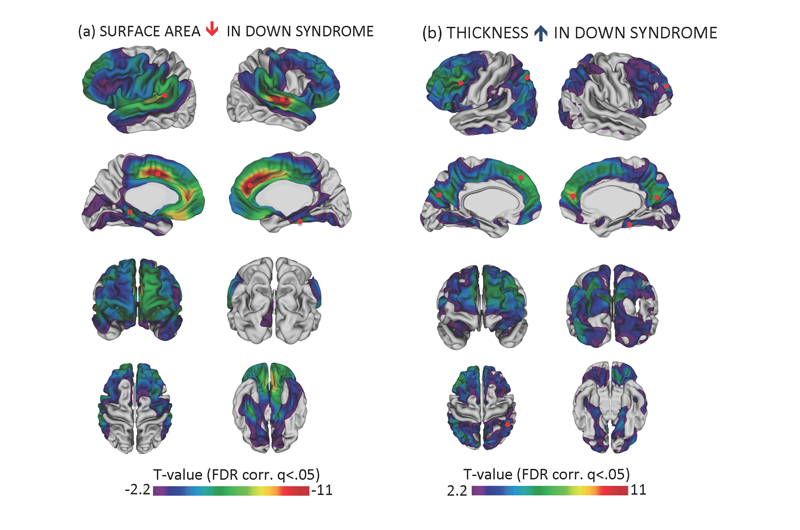
Thick Cortex Could Be Key in Down Syndrome

Reductions in cortical surface area and increases in cortical thickness in brains of youth with Down Syndrome relative to typical controls. Panel (a) displays surface area findings; panel (b) displays cortical thickness findings. The approximate location of peak regions in which cortical surface area and thickness were most different from control are marked with small red circles. Credit: Lee et al., National Institute of Mental Health. – See more at: http://drexel.edu/now/archive/2015/June/Down-Syndrome-Cortex/#sthash.r2hp48On.dpuf

Originally posted on DrexelNow.

The thickness of the brain’s cerebral cortex could be a key to unlocking answers about intellectual development in youth with Down Syndrome. It could also provide new insights to why individuals with this genetic neurodevelopmental disorder are highly susceptible to early onset Alzheimer’s Disease later in life.
(more…)

Do Insect Societies Share Brain Power?

Originally posted on DrexelNow.

The society you live in can shape the complexity of your brain—and it does so differently for social insects than for humans and other vertebrate animals.

A new comparative study of social and solitary wasp species suggests that as social behavior evolved, the brain regions for central cognitive processing in social insect species shrank. This is the opposite of the pattern of brain increases with sociality that has been documented for several kinds of vertebrate animals including mammals, birds and fish.

“By relying on group mates, insect colony members may afford to make less individual brain investment. We call this the distributed cognition hypothesis,” said Sean O’Donnell, PhD, a professor in the Drexel University College of Arts and Sciences who led the study published today in Proceedings of the Royal Society B.
(more…)