Category: Science

Study of African Birds Reveals Hotbed of Malaria Parasite Diversity

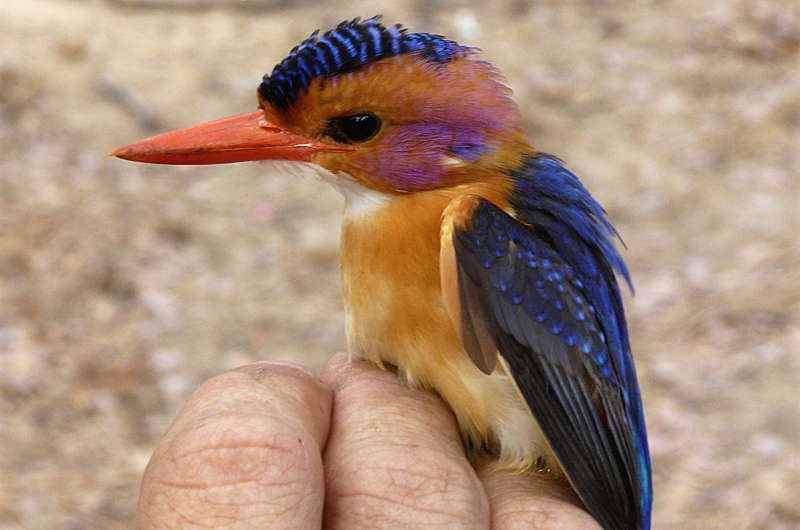
African Pygmy Kingfisher (Ispidina picta) photographed in Vwaza Wildlife Reserve, Malawi. Credit: Jason D. Weckstein

Originally posted on DrexelNow.

When you think of tropical biodiversity, you may picture flocks of colorful birds flitting through lush foliage—but what you are less likely to imagine is the plethora of parasites and pathogens pulsing through the bloodstreams of those birds. Among these microscopic organisms are Plasmodium parasites, best known for causing malaria in humans, birds and many other vertebrates.

A new study published this week in the journal PLOS ONE explores the scope of malaria parasite diversity in southeast African birds, and provides insight into how lifestyle characteristics of birds can influence their association with different parasite genera. The study considers haemosporidian (blood) parasites in the genus Plasmodium, as well as closely-related parasites in the genera Haemoproteus and Leucocytozoon. Understanding the patterns of how those parasites are transmitted across populations and different species of birds can help unlock a better understanding of disease movements in the environment.

Among hundreds of birds sampled during two months of field work in the southeastern African nation of Malawi, an astonishing proportion of the birds—79 percent—were infected with haemosporidian parasites. Even more surprising was the number of novel malaria parasite lineages scientists discovered in Malawian birds.

“A large proportion, 81 percent, of the parasites that we detected are new, previously undocumented lineages of Plasmodium, Haemeoproteus and Leucocytozoon,” said study co-author Jason Weckstein, PhD, an associate professor at Drexel University in the College of Arts and Sciences and the associate curator of ornithology at the Academy of Natural Sciences of Drexel University.

The study, led by Holly Lutz, a PhD candidate at Cornell University, was conducted under the auspices of the Emerging Pathogens Project at the Field Museum of Natural History in Chicago, and included collaborators from the Field Museum, the Cornell Lab of Ornithology and the University of North Dakota. Lutz and Weckstein began collaborating when Lutz was an undergraduate student at the University of Chicago and worked with Weckstein on a National Science Foundation funded project.

“We typically think of malaria as a human disease, but in reality, the vast majority of haemosporidian parasites infect birds, reptiles and non-human mammals,” said Lutz. “Studying how other animals interact with and combat these parasites could provide us with important insights for the fight against human malaria.”

The effects of these parasites in wild animals range from mild to severe. In one of the most dramatic examples, avian Plasmodium parasites introduced by humans to naïve bird communities in Hawaii ultimately led to the extinction of at least 10 native bird species. Despite such devastation in Hawaiian birds, the effect of naturally occurring haemosporidian parasites in wild populations is poorly known.

By studying a large and diverse sample of birds, Lutz, Weckstein and their colleagues were able to draw several associations between birds’ lifestyle habits and their patterns of parasitic infection: “We found that bird species aggregating in single-species flocks experienced a lower probability of infection by Plasmodium parasites and a higher probability of infection by Haemoproteus parasites, relative to birds that are solitary or living in mixed-species flocks,” Weckstein said.
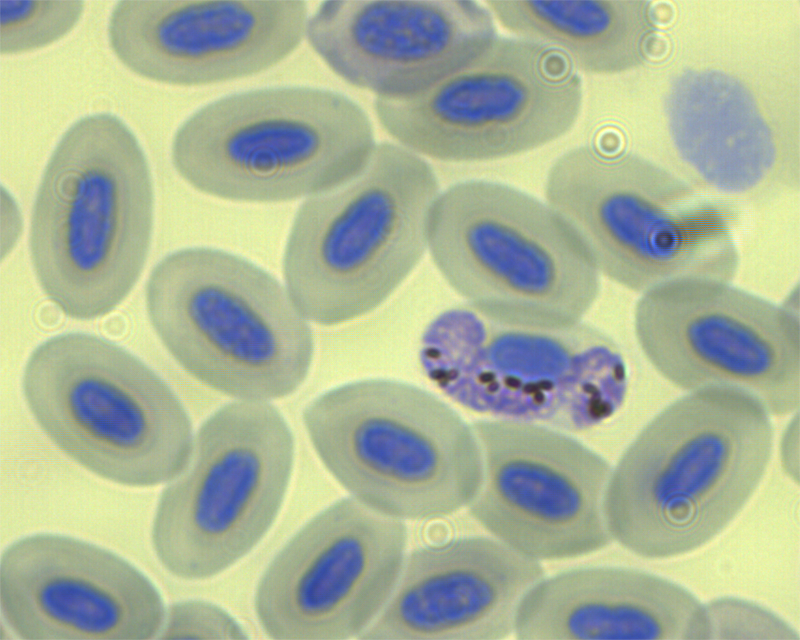
Haemoproteus parasites infect one of the red blood cells shown in this sample taken from a bird in Malawi. Credit: Jacob Mertes, University of North Dakota

The diversity of parasites found here indicate that this region of southeast Africa is a prime area to study the mechanisms of host-parasite interactions—and, Weckstein said, knowing more about the diversity of haemosporidian parasites infecting birds here helps complete the picture across Africa. Scientists now have data from across the continent, including Malawi, Mozambique, Congo, Uganda and Kenya. “This will increase our sample sizes and give us a chance to look more broadly at how host specific some of these parasites are (how many host species they infect) and how geographically specific they are (whether particular parasites are only found in some regions and not others).”

Weckstein hopes future research will yield more information about the vector species that transmit the parasites between avian hosts. Based on the high prevalence and diversity of haemosporidian parasites found in this region, the fly and mosquito species which transmit these parasites are believed to have diverse lifestyle characteristics as well. The patterns of infection that vary between birds with different lifestyle habits likely reflect differences in the biology of vector insects. Understanding these vector species is critical to making sense of the complex interactive systems involving diverse sets of hosts, parasites and vectors in this environment.

– See more at: http://drexel.edu/now/archive/2015/April/African-Birds-Malaria-Diversity/#sthash.7up1SZ1o.dpuf

How to Harness the Science of Sparking Ideas

Originally posted on DrexelNow.

When you say “aha!” at the spark of a surprising new idea or creative solution to a problem, the idea seems to come out of nowhere. But when such insights pop up without your conscious awareness, how can you train your brain to deliver more of them?

Creative ideas tend to come to people all of a sudden, sometimes in the shower or, famously in the case of Archimedes, who shouted “Eureka!” and ran naked through the streets of ancient Syracuse, in the bath. But, like all ideas, they originate in the brain.

For Drexel psychology professor John Kounios, PhD and his longtime collaborator Mark Beeman, PhD, at Northwestern University, the brain science of  “aha! moments” has been a major focus of their careers. In 2004, the pair sprang to international acclaim with their discovery that “aha moments” originate in a key spot of the brain’s right hemisphere just above the right ear—putting to rest the question of whether sudden insight was indeed a separate form of problem-solving from more deliberate analytic processes. For the next decade, they’ve continued to refine their studies of how creativity, especially sudden insight, works in the brain and in practice.

Now, the two have co-authored a new book bringing that science to life and offering a comprehensive picture of the state of scientific knowledge about insight: “The Eureka Factor: Aha Moments, Creative Insight, and the Brain” (Random House, 2015). It’s the first book about creativity that tells a complete and faithful story of the neuroscience written by the actual scientists who made the discoveries.

The book is packed with anecdotes about creative insights—from character design at Disney Pixar to a concert promoter tasked with pleasing Elvis Presley—taking each story as an object lesson in the ways creativity works in the brain, according to the latest research.

The book also highlights numerous examples and recommendations of techniques to improve creativity—but, Kounios notes, such recommendations must be used with care. Factors including sleep, mood, motivation and working environment can all affect insight and can be modified to inspire more creativity, if handled with appropriate knowledge of what to do.

“There are strategies to be more creative, but you have to understand the process in the brain to use them correctly,” said Kounios, who directs Drexel’s doctoral program in applied cognitive and brain sciences in the College of Arts and Sciences. “Otherwise, the strategy can have opposite of your intended results.”

For example, Kounios noted that a positive mood often enhances creativity—but not if a person is perpetually sunny. “Creativity requires multiple perspectives, so you need something to jar you out of that state of mind, even if it happens to be sad.”

– See more at: http://drexel.edu/now/archive/2015/March/Creative-Insight-Eureka-Factor/#sthash.V7Ai5bCg.dpuf

Studies of Africa’s Most Endangered Chimpanzees Show Complex Evolutionary Past, Perilous Future

Photo credit: Paul Sesink Clee

Originally posted on DrexelNow.

In central Cameroon, two different subspecies of chimpanzees live on opposite banks of the Sanaga River, the only instance of two different chimp subspecies living in the wild in a single country. The area is roughly at the geographic center of the range for all four known subspecies of these great apes.

But when a team of scientists recently took a close look at the genetics of central Cameroon’s wild chimpanzees, they didn’t find two distinct populations; there were three.

“It blew away our assumptions,” said Matthew Mitchell, PhD, a postdoctoral fellow, at Drexel University. “We had always thought that the only genetic difference across populations would be between the two subspecies, and that the differences came from the division across the Sanaga River, but now we see there is more to the picture.” Mitchell was first author of two of three new papers about this chimpanzee research with his advisor Mary Katherine Gonder, PhD, an associate professor in Drexel’s College of Arts and Sciences, other lab members and an international team of collaborators, published this week in BMC Evolutionary Biology.

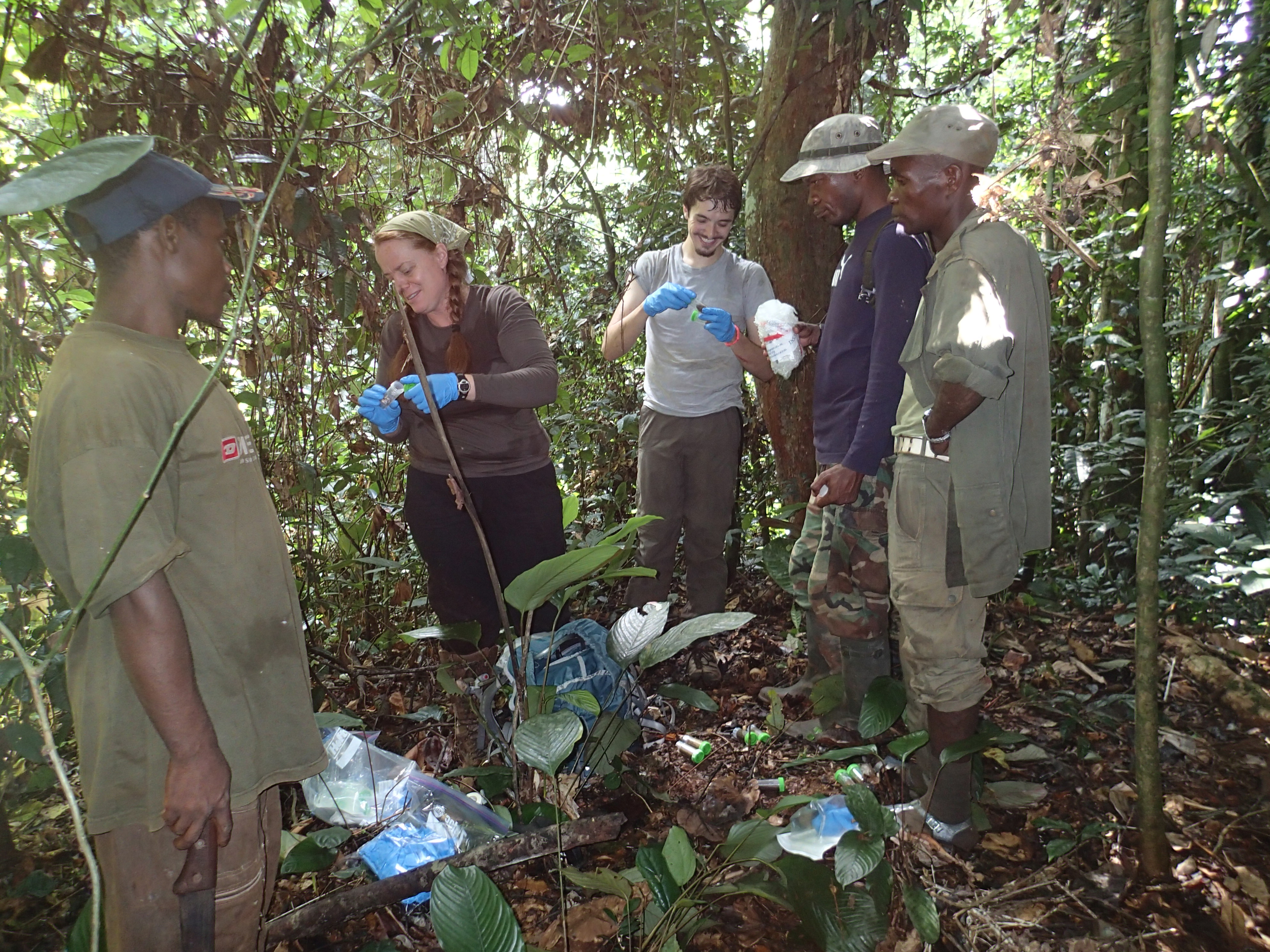
Mary Katherine Gonder and Paul Sesink Clee (at center of group) processing chimpanzee fecal samples for genetic analyses. Credit George Ghamu

The team’s complementary analyses of population genetics, geographical distribution and habitat use paint a new picture of the evolutionary past and potentially bleak future of the Nigeria-Cameroon Chimpanzee (Pan troglodytes ellioti), already the most endangered chimp subspecies, with about 6,000 individuals estimated in the wild. They are already threatened by illegal hunting and habitat loss to both logging and agricultural plantations.

Now, among other findings, the scientists report that the two distinct populations of the Nigeria-Cameroon chimpanzee have closer ties to their habitats than previously anticipated. And their findings also suggest climate change could cause significant  harm to chimpanzee populations due to habitat alterations.

The research team, one of the few groups studying Nigeria-Cameroon chimpanzees in the wild, collected fecal and hair samples for genetic analyses. They also mapped the precise locations of those sample collection sites in addition to locations of reports of chimp sightings and evidence of activity including nests and tools.

“The Nigeria-Cameroon chimpanzee is perhaps the least studied of all chimpanzee subspecies,” said Paul Sesink Clee, a doctoral candidate in Gonder’s lab, who was first author of a paper detailing habitat distribution and modeling impacts of climate change. “This is the first time that their distribution and habitat has been studied in such detail, and the data used to predict how their habitats might degrade under climate change.”

Where Distinct Ecosystems Meet, An Unexpectedly Different Population of Chimps Occurs

Central Cameroon is noteworthy not just as a place where two chimp subspecies meet. It’s also the place where the species-rich, mountainous Gulf of Guinea region abuts the distinct, but comparably diverse, lowland Congo River Basin. Together, these two ecosystems contain about 20 percent of all plant and animal species on the entire planet, and many of those species are endemic—found only here in central Africa.

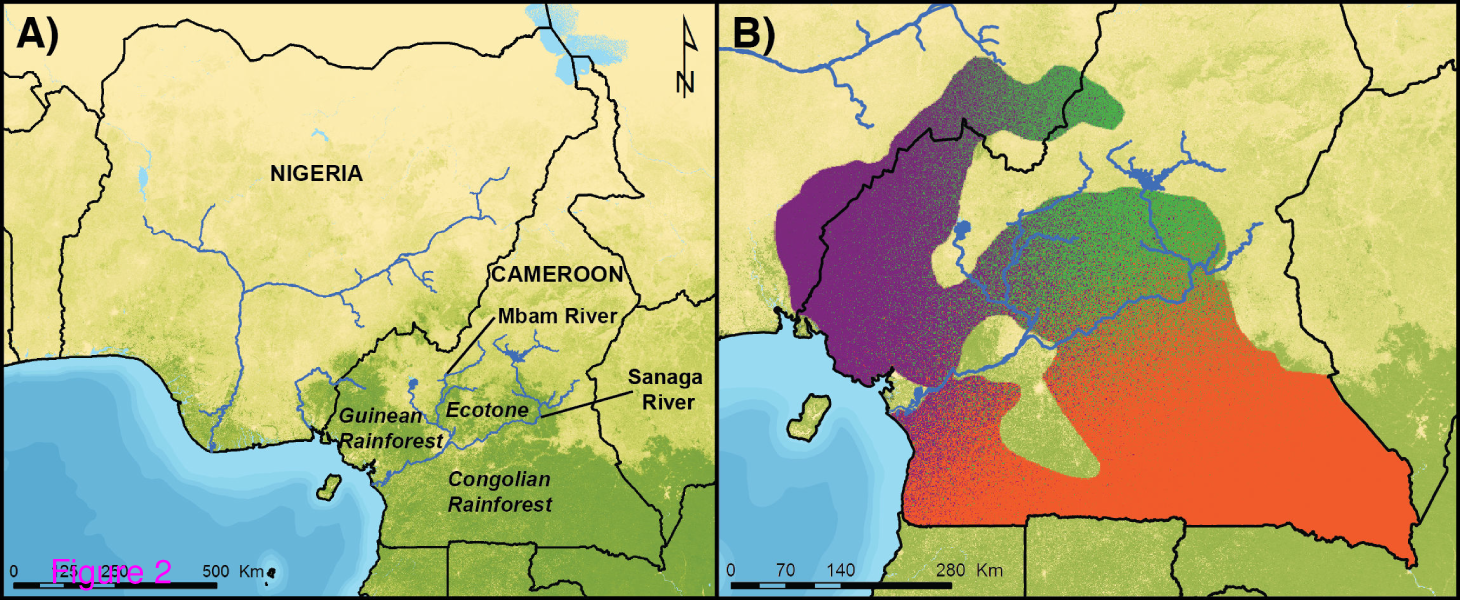
Habitat Types and Chimpanzee Population History in Cameroon and Nigeria. Credit: Sesink Clee et al.

These different rainforest ecosystems converge with savanna in central Cameroon forming a savanna-woodland mosaic known as an ecotone.

“This ecotone is associated with driving diversification in a lot of different species,” Mitchell said. Ecotones are thought to be important in driving variation and diversification of species all over the world.

This particularly fragile savanna-woodland mosaic habitat in central Cameroon north of the Sanaga River is where Mitchell’s genetic analysis identified a population of Nigeria-Cameroon Chimpanzees that was distinct from those living in the mountainous rainforests of northwest Cameroon and eastern Nigeria. They also determined that the population in the ecotone diverged from the western rainforest population about 4,000 years ago —while still remaining closely related members of the same subspecies. (In contrast, this subspecies as a whole diverged from the Central Chimpanzee subspecies (Pan troglodytes troglodytes), whose populations live in Congo River Basin forests south of the Sanaga River, about 200,000 years ago or more.)

In subsequent modeling in a second paper, Mitchell and colleagues concluded that in the Nigeria-Cameroon chimpanzee, a significant amount of genetic difference could come from adaptation to different environments.

In short, these chimps have changed in distinct, genetically noticeable ways, to their lives in different habitats.

Environments Threatened by Climate Change

Yet the habitats these chimps rely on may be particularly threatened, the team’s analysis has showed.

“We were surprised to see that the Nigeria-Cameroon chimpanzees living in the savanna-woodland habitat of central Cameroon are under the most immediate threat of climate change, and may completely lose their habitat within our lifetime,” said Sesink Clee.

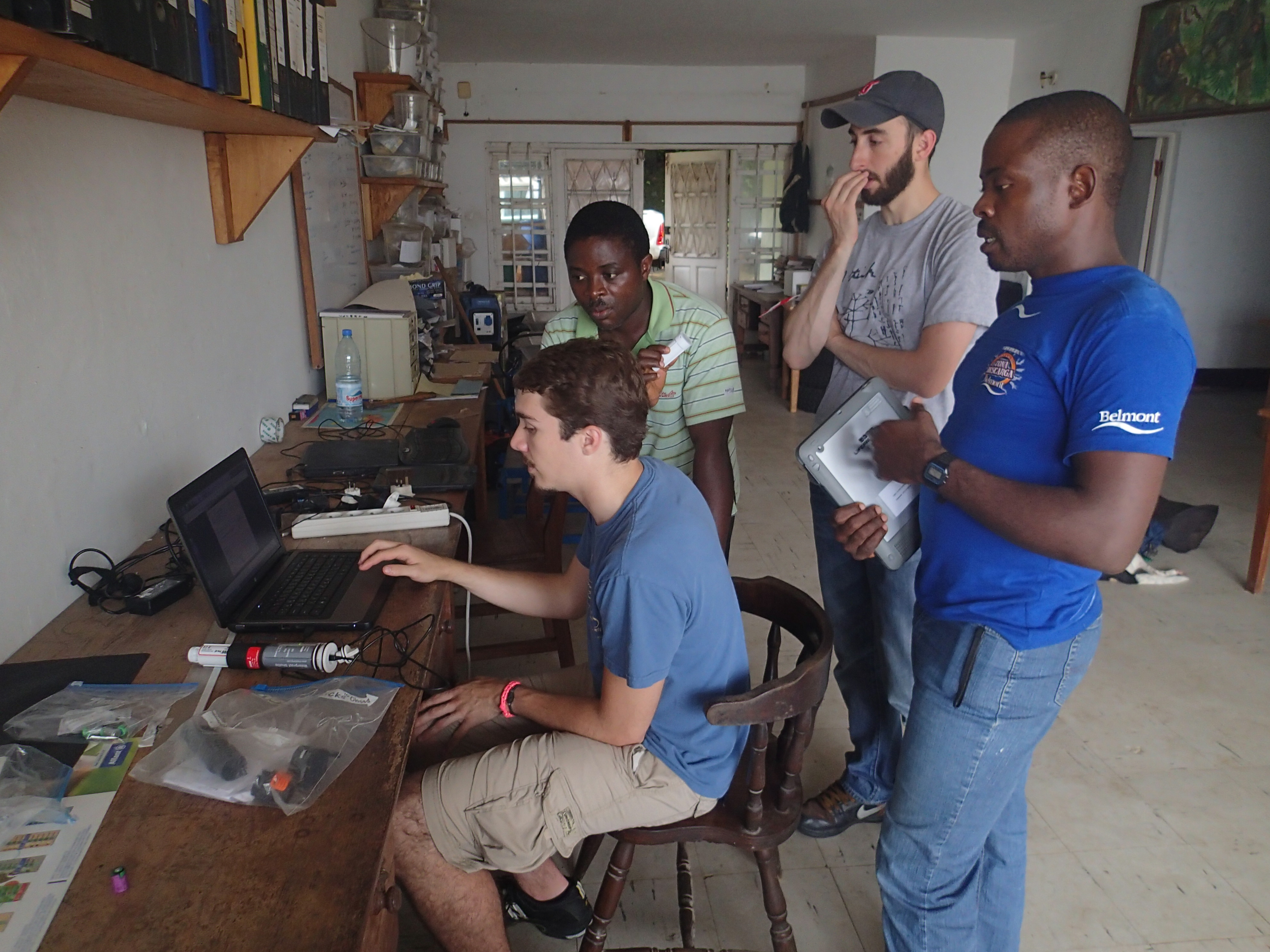
Drexel University researchers Paul Sesink Clee (seated) and Matthew Mitchell (standing, center) analyzing climate data from a field site with researchers from Ebo Forest Research Project. Credit Mary Katherine Gonder

He and colleagues reached this conclusion based on combining detailed chimpanzee location data with the environmental characteristics of these locations. They then predicted how these habitats would change under climate change scenarios for years 2020, 2050, and 2080. The scenarios were provided by the UN’s Intergovernmental Panel on Climate Change and considered a varying range of factors including use of fossil and non-fossil fuels, human population growth, and environmental protection efforts.

While the team predicted little change in the mountainous rainforest habitat, the ecotone habitat of the second population was predicted to decline quickly under all scenarios by the year 2020 and could disappear almost entirely under the worst case scenario by 2080. With roughly half of the 6,000 Nigeria-Cameroon chimpanzees existing in the ecotone habitat of central Cameroon, the results suggest that this subspecies of chimpanzee is particularly vulnerable to climate change.

The authors note that their models may be something of a worst-case scenario for climate change because they do not take into account the potential for these chimpanzee populations to adapt to the changes brought about by climate change, or to migrate to new areas with optimal conditions. On the other hand, chimpanzees continue to face other threats of habitat loss to human land uses, as well as illegal hunting.

“We know very little about Nigeria-Cameroon chimpanzees in the wild,” said Gonder. “But everything we have learned about them suggests that Cameroon is a particularly vital location for preserving the diversity found within the species.  The governments of Cameroon and Nigeria have made important strides in the last five years to save their chimpanzee remaining populations.  The papers published this week in BMC Evolutionary Biology will boost these efforts by providing a solid foundation for policy makers in these countries to make stronger arguments for additional protection in places, such as central Cameroon, which have often been overlooked in ape conservation planning activities.”


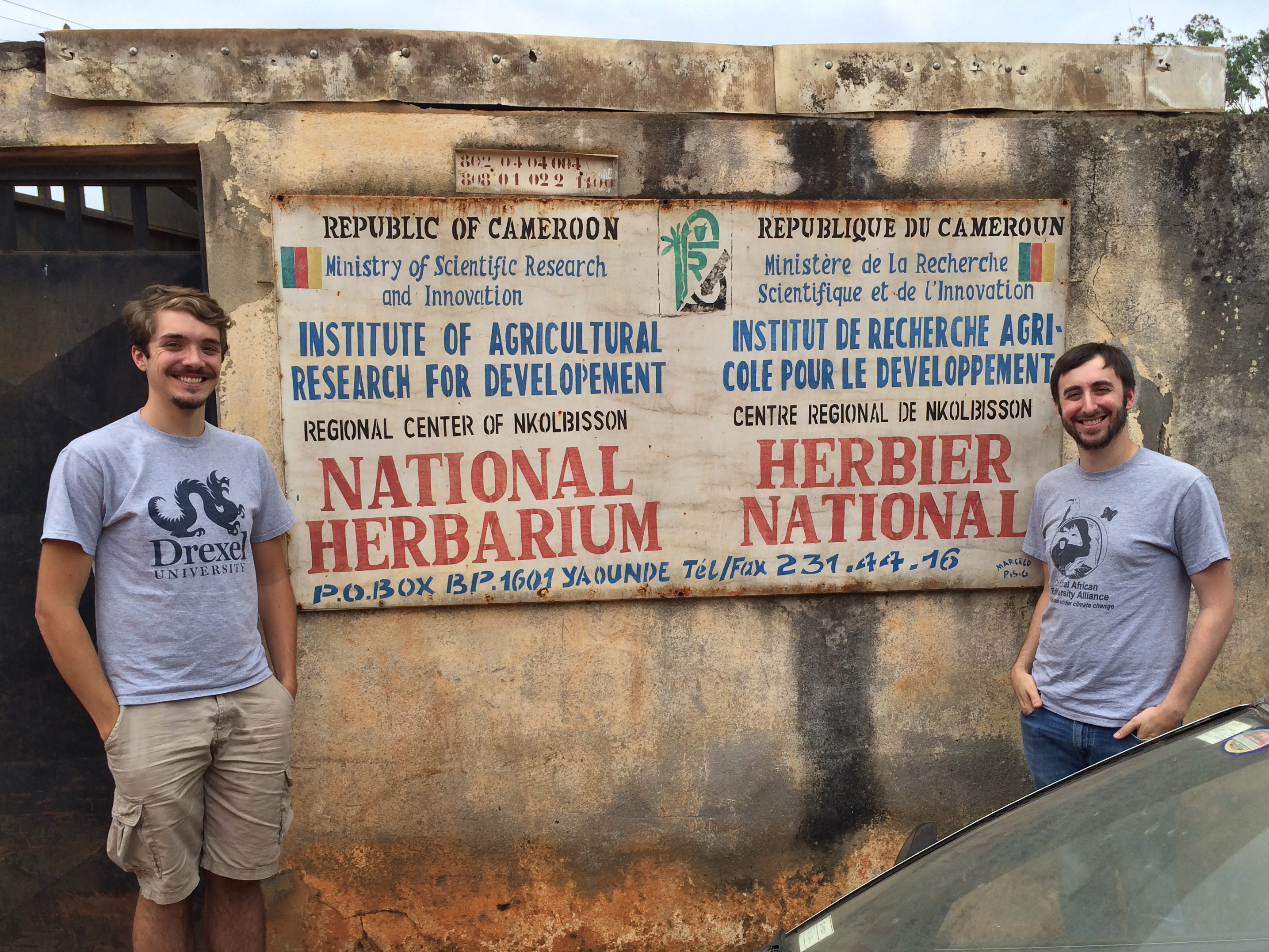
Paul Sesink Clee (left) and Matthew Mitchell (right) in Cameroon

For more about the process of the research described above, see the blog post by Gonder, Mitchell and Sesink Clee on the BMC Series Blog.

For more information about Drexel University’s ongoing research projects in Central Africa, please visit: caballiance.org and bioko.org

For more information on the Nigeria-Cameroon chimpanzee or to read the IUCN conservation action plan, please visit: ellioti.org

For more information on the Gonder Lab at Drexel University, please visit: pages.drexel.edu

Portions of this article were adapted with permission from a press release prepared by BMC Evolutionary Biology.

Images are available for use by the media (with credits provided in file names) here.

The three papers published in BMC Evolutionary Biology are available here:

– See more at: http://drexel.edu/now/archive/2015/January/Endangered-Chimpanzee-Studies/#sthash.lWorlOMU.dpuf

Drexel Snapshot x2: Conserving Central African Wildlife Diversity

Drexel News Blog Central Africa’s Congo Basin is a biodiversity hotspot, meaning it’s a region with an incredibly rich array of plants and animals, many of which are found nowhere else—and which face threats to survival that include deforestation, climate change and hunting. A Drexel … Continue reading Drexel Snapshot x2: Conserving Central African Wildlife Diversity