Category: Health

Driving Safety Research Gets Traction as Business Venture

Originally published in two versions, on Cornerstone, the CHOP Research Blog, and in Bench to Bedside, the CHOP Research monthly publication

I composed these original articles based on interviews with the investigators.

Excerpt:

If you do not expect pediatric research to have anything to do with improving the bottom line of a parcel delivery service or cable company, then the story of Diagnostic Driving may surprise you.

Diagnostic Driving, a startup company spun out from The Children’s Hospital of Philadelphia Research Institute, has spent the past several months accelerating from an idea based on teen driver safety research into a thoroughly researched, successfully piloted business model for improving the safety of corporate automotive fleets. At the end of October, Venk Kandadai, MPH, co-founder of the company, traveled across the country presenting Diagnostic Driving’s success to date and seeking investments so the company can continue its growth.

The company’s journey is an illustration of what a growing number of CHOP-generated ideas may experience soon under the guidance of the new Office of Entrepreneurship & Innovation.

To trace this company’s road from research to the startup world, let’s hit reverse and see where it began.


HealthCare.Gov Upgrades Are Just What This Doctor Ordered

Originally published on Cornerstone, the CHOP Research Blog

I composed this original blog post based on an interview with the investigator and aggregation of related published material.

Excerpt:

When the third round of open enrollment begins on the federal health insurance marketplace Nov. 1, shoppers will see some major changes. These changes might be just what the doctor ordered — if the doctor you are talking to is Charlene Wong, MD, MSHP, a health policy researcher and adolescent medicine fellow at The Children’s Hospital of Philadelphia.

Dr. Wong and colleagues have studied how young adults experience the use of the federal site, HealthCare.gov, and state-based exchanges. Access to health care in this age group is critical for the success of the Affordable Care Act (ACA), as well as for setting young adults up for healthy lives with regular preventive care services.

Universal Autism Screening in Young Children Under Question

Originally published on Cornerstone, the CHOP Research Blog

I wrote the introduction and edited the body of this article based on a Q&A published by Medscape.

Excerpt:

Many parents and clinicians are in a bind between conflicting recommendations about autism. Newly issued recommendations by the U.S. Preventive Services Task Force (USPTSF) suggest that current evidence is not strong enough to justify universal screening for the condition in young children. The American Academy of Pediatrics takes an opposite stance and supports such screenings— typically a structured parental survey and short interview about a child’s behavior — for toddlers at 18 and 24 months of age.

How are autism experts weighing in about this conflict? Two experts from the Center for Autism Research at The Children’s Hospital of Philadelphia, David Mandell, ScD, the center’s associate director, and Juhi Pandey, PhD, a pediatric neuropsychologist, participated in a Medscape Q&A to answer many key questions. In their in-depth conversation with the publication, Dr. Mandell and Dr. Pandey discussed the role of early autism screening compared to comprehensive clinical evaluation, as well as the value of early intervention for children who show signs of developmental delay on a screening.

Young Investigator Seeks a Target for Targeted Neuroblastoma Therapy

Originally published on Cornerstone, the CHOP Research Blog

I composed this original blog post based on an interview with the investigator and took the accompanying photo.

Excerpt:

It is scary to learn your child has neuroblastoma, a tumor of the peripheral nervous system that is the most common cancer in infants. It is scarier still when you get test results that show your child is in the half of neuroblastoma patients whose cancer is very aggressive and high-risk. Doctors routinely test neuroblastoma tumor genes to see if there are multiple extra copies of the gene MYCN. Positive results come with that high-risk prognosis. Amplified MYCN occurs in about half of all high-risk neuroblastoma cases.

Currently, there is not a good answer for parents facing this scenario. Doctors have known about the association between amplified MYCN and poor neuroblastoma outcomes for more than 30 years, but that knowledge has not yet translated into improved, targeted treatments.

One researcher who is now trying to make the start of that translation is Robyn Sussman, PhD, a postdoctoral fellow at The Children’s Hospital of Philadelphia. Dr. Sussman has just received a two-year Young Investigator grant from the Alex’s Lemonade Stand Foundation (ALSF) to pursue this line of research. This week, she is joining 50 researchers from across the country at the third ALSF Young Investigator Summit to learn from and engage with leading researchers in pediatric oncology.

No Rush for Eye Disease Screening in Most Children With Diabetes

Originally published on Cornerstone, the CHOP Research Blog

I composed this blog post as a follow-up to a CHOP press release on the same study, based on an interview conducted by a colleague.

Excerpt:

Something surprising happened when Gil Binenbaum, MD, MSCE, and his colleagues in the Division of Ophthalmology at The Children’s Hospital of Philadelphia examined children with diabetes: They kept failing to find what they were looking for.

“We examined many kids for diabetic eye complications, and they didn’t have diabetic retinopathy,” said Dr. Binenbaum, an eye surgeon, who is also an assistant professor of ophthalmology at the Perelman School of Medicine at the University of Pennsylvania.

Diabetic retinopathy (DR) is one of many potential complications caused by diabetes’ effects on the body’s blood vessels. Although DR can damage retinal tissue and seriously impair vision, the severe form of the condition is quite rare in children, regardless of how long they have had diabetes or how well they control their blood glucose levels, Dr. Binenbaum noted.

Pregnancy is a Missed Opportunity for HIV-Infected Women to Gain Control Over Condition

Originally posted on DrexelNow.

Pregnancy could be a turning point for HIV-infected women, when they have the opportunity to manage their infection, prevent transmission to their new baby and enter a long-term pattern of maintenance of HIV care after giving birth—but most HIV-infected women aren’t getting that chance. That is the major message from a pair of new studies in Philadelphia, one published early online this month in the journal Clinical Infectious Diseases, and the other published in July in PLOS ONE.

The studies, led by a team of researchers from Drexel University and the Philadelphia Department of Public Health (PDPH), are the first to describe the HIV care continuum postpartum and the first to use population-based data to evaluate viral suppression rates of HIV-infected pregnant women at delivery. Both studies were based on the review of medical records of all HIV-infected women delivering babies in Philadelphia over several years (2005-2011 and 2005-2013, respectively). (more…)

Autism/Autismo: Films Reach Diverse Audiences with Families’ Personal Stories

Drexel News Blog This spring, a set of videos premiered in Philadelphia, documenting the experiences of local African-American families as each dealt with a child’s autism diagnosis. The films, produced by social worker Karen Krivit with a team of Drexel television management students, sought to … Continue reading Autism/Autismo: Films Reach Diverse Audiences with Families’ Personal Stories

Quick Takes: Obamacare and Same-Sex Marriage are Both Public Health Issues

Drexel News Blog The Supreme Court issued its rulings today in the King v. Burwell case, upholding Obamacare’s subsidies and protecting access to affordable health care for millions of low- and middle-income Americans—a major victory in the view of most public health experts. Robert I. … Continue reading Quick Takes: Obamacare and Same-Sex Marriage are Both Public Health Issues

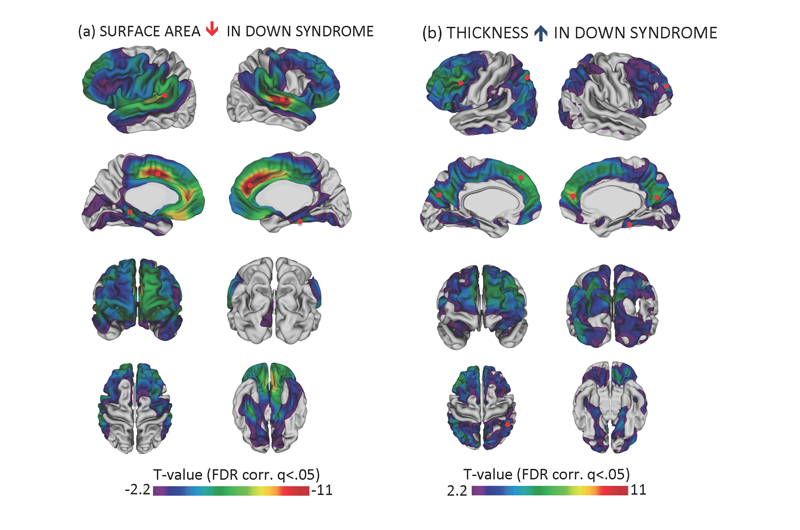
Thick Cortex Could Be Key in Down Syndrome

Reductions in cortical surface area and increases in cortical thickness in brains of youth with Down Syndrome relative to typical controls. Panel (a) displays surface area findings; panel (b) displays cortical thickness findings. The approximate location of peak regions in which cortical surface area and thickness were most different from control are marked with small red circles. Credit: Lee et al., National Institute of Mental Health. – See more at: http://drexel.edu/now/archive/2015/June/Down-Syndrome-Cortex/#sthash.r2hp48On.dpuf

Originally posted on DrexelNow.

The thickness of the brain’s cerebral cortex could be a key to unlocking answers about intellectual development in youth with Down Syndrome. It could also provide new insights to why individuals with this genetic neurodevelopmental disorder are highly susceptible to early onset Alzheimer’s Disease later in life.
(more…)