Category: Writing

STEM Teaching Innovation, Mentoring at Drexel to Expand with HHMI Grant for Improving Undergraduate Retention

Originally posted on DrexelNow.

Drexel University has been awarded funding from the Howard Hughes Medical Institute (HHMI) of $1.2 million over five years to implement strategies intended to increase the retention of undergraduate students in science, technology, engineering and math (STEM) majors. Drexel’s project is focused on the theme of developing communities that improve student learning and faculty use of teaching approaches that improve retention.

Drexel is one of only 37 institutions nationwide to receive the grant, out of 203 research universities invited to apply. HHMI issued this challenge for universities to develop effective strategies that will lead to significant and sustained persistence in science by all students, including those students who belong to groups underrepresented in science.

The programs address a significant point in the STEM education pipeline at which many students do not persist: The early years of undergraduate education. Sixty percent of all undergraduates who begin college intending to major in STEM subjects do not complete a bachelor’s degree in STEM – a number that rises to 80 percent among undergraduates from underrepresented racial and ethnic groups. Most of the attrition occurs in the first two years of college, when students are taking introductory courses in chemistry, math and biology.

The announcement of HHMI’s awards funding undergraduate STEM retention programs follows closely on the U.S. White House earlier this week announcing several initiatives to improve STEM education and mentoring for students in K-12 classrooms. Philadelphia was selected as one of seven cities that will engage in the US2020 mentoring program for youth in STEM.

In Drexel’s program, communities of incoming undergraduate STEM students will be formed in a freshman year course. The course will provide role models (upper level undergraduates and faculty) that will foster team building to support student academic and social success. This community development is intended to help students with their adjustment to college life, support their feeling of belonging within the Drexel community and help develop deeper intellectual connections for students within their intended STEM major. All of these factors are known to improve student retention. Drexel already requires all first-year students to participate in the UNIV-101 “Drexel Experience” course that places all students in a cohort of other students from their major – providing an ideal structure in which to establish the new mentored student learning communities.

Selected STEM faculty at Drexel will also engage in mentored learning communities, supporting their development as innovative educators who teach using tools known to be the most effective in supporting student learning.

“Teaching strategies that engage students in the classroom have been demonstrated to improve STEM student retention,” said Jennifer Stanford, PhD, an assistant professor of biology in the College of Arts and Sciences who is taking a leading role in implementing this project. “This includes approaches such as group problem solving, answering questions on course content with immediate feedback, case discussions or in-class debates.”

The program will provide additional support for faculty who are incorporating these approaches into their classrooms providing incentives, such as a yearly award that recognizes innovative teaching.

These strategies will impact students in all STEM disciplines and will engage STEM faculty and administrators across Drexel, in all colleges and schools where STEM majors are offered.

“It is our intention that these HHMI funded initiatives will be sustained long after the five-year award is finished,” said Donna Murasko, PhD, dean of the College of Arts and Sciences and principal investigator on Drexel’s HHMI grant. “We also intend to share our findings on STEM educational research with STEM educators across the region and nation. To accomplish this, Drexel will host a yearly symposium to bring together faculty and administrators from partner institutions to present outcomes from activities intended to improve STEM education.”

“We anticipate that this culture of mentored communities will become the hallmark of STEM disciplines within Drexel University, and will serve as a model for improving STEM education on other campuses,” Murasko said.

As part of this grant, Drexel will develop a Center for the Advancement of STEM Teaching and Learning (CASTL). CASTL will bring together faculty, administrators, students and staff from across Drexel’s campus to collaborate on projects focused on improving STEM education. Such projects will include providing training to faculty and students interested in learning how to teach STEM students more effectively and developing research projects to understand how to improve methods of teaching STEM students.

Additional Drexel faculty members were instrumental in developing this multidisciplinary project were: Daniel King, PhD, associate professor of chemistry in the College of Arts and Sciences and Aleister Saunders, PhD, associate professor of biology and associate dean of the College of Arts and Sciences.

Mark Greenberg, PhD, provost of the University, Joseph Hughes, PhD, dean of the College of Engineering and David Fenske, PhD, dean of the College of Computing and Informatics will serve with Murasko on the executive committee to oversee the implementation of the project.

Drexel is the only university in Philadelphia to receive this competitive grant from HHMI. Other recipients in Pennsylvania are Lehigh University and the University of Pittsburgh.

– See more at: http://drexel.edu/now/archive/2014/May/STEM-Major-Retention/

A Tiny, Toothy Catfish with Bulldog Snout Defies Classification

Originally posted on DrexelNow.

Kryptoglanis shajii is a strange fish – and the closer scientists look, the stranger it gets. This small subterranean catfish sees the light of day and human observers only rarely, when it turns up in springs, wells and flooded rice paddies in the Western Ghats mountain region of Kerala, India. It was first described as a new species in 2011.

Soon after that, John Lundberg, PhD, one of the world’s leading authorities on catfishes, started taking a closer look at several specimens.

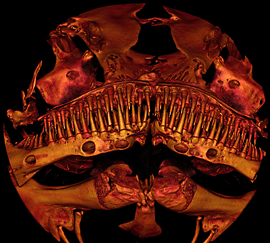
A close-up scanned image of the bony structures in the fish's toothy face -- somewhat resembling the creature from the movie Alien. Credit: Mark L. Riccio, Cornell University BRC CT Imaging Facility

A close-up scanned image of the bony structures in the fish’s toothy face — somewhat resembling the creature from the movie Alien. Credit: Mark L. Riccio, Cornell University BRC CT Imaging Facility

“The more we looked at the skeleton, the stranger it got,” said Lundberg, emeritus curator of Ichthyology at the Academy of Natural Sciences of Drexel University and emeritus professor at Drexel in the College of Arts and Sciences. His team’s study describing the detailed bone structure of Kryptoglanis is now published in the 2014 issue of the Proceedings of the Academy of Natural Sciences of Philadelphia.“The characteristics of this animal are just so different that we have a hard time fitting it into the family tree of catfishes,” said Lundberg.

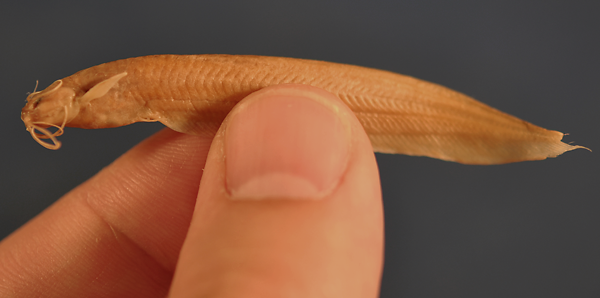
From the outside, Kryptoglanis does not look particularly unusual for a catfish. But when Lundberg and his colleagues looked at its bones using digital radiography and high-definition CAT scans, they found some surprises.

Kryptoglanis was missing several bony elements – a characteristic fairly common for subterranean fish. But there were also changes in the shapes of certain bones, changes so strange that Lundberg described them as “completely unique among catfishes and all fishes as far as I know.”

A specimen of the fish Kryptoglanis shajii, held in a man's fingers to indicate size

Above: A specimen of Kryptoglanis shajii that was scanned in Lundberg’s team’s study. Credit: Kyle Luckenbill, Academy of Natural Sciences of Drexel University

Numerous individual bones were modified in the face, giving the fish a compressed front end with a jutting lower jaw – like a bulldog’s snout, if a bulldog also had four rows of conical, sharp-tipped teeth.

Multiple changes piled up in one part of the body could mean there is a functional purpose for those changes. “In dogs that was the result of selective breeding. In Kryptoglanis, we don’t know yet what in their natural evolution would have led to this modified shape,” Lundberg said.Based on its teeth and subterranean home, Lundberg said that Kryptoglanis most likely eats meat, in the form of small invertebrates and insect larvae – whatever might be found in the groundwater and could be captured by the fish, which at less than ten centimeters is smaller than an adult human’s pinkie finger. The fish can move swiftly in its environment, as evidenced by video footage of collected fish darting through water to grab food. [Source]

But why Kryptoglanis is so different, and what its closest relatives are, remains a mystery.

Lundberg’s team wasn’t alone in asking the question. Lundberg’s team examined three specimens of Kryptoglanis using digital radiography, and one of these specimens using high-resolution X-ray computed tomography – resulting in detailed, three-dimensional CAT scan images after careful preparation and analysis by Lundberg’s colleague and co-author, Kyle Luckenbill, interim collection manager and a research assistant at the Academy. (A video visualization of the fish’s internal bony structures is available at http://youtu.be/PBqndwVdnrc and embedded below.)

At the same time, a separate team led by Ralf Britz at the Natural History Museum of London independently examined the bone structure of Kryptoglanis using a technique of visualizing the skeleton called clearing and staining – a chemical method in which the fish’s soft tissues are rendered as clear as glass and bones and cartilage are stained in contrasting colors. This team’s description of the structures was published in the March 2014 issue of the journal Ichthyological Exploration of Freshwaters.

“There was an amazing congruence between the results,” Lundberg said. “Neither of us was way out.”

Neither could figure out which other catfishes Kryptoglanis was most closely related to, although Britz’s team chose to assign it to its own new taxonomic family within the order of catfishes.

This fish just one of many unresolved branches on the catfish family tree, in a section where even DNA evidence has thus far proven unhelpful. Subterranean species like Kryptoglanis tend to have dramatically different DNA sequences from one another and from their open-water relatives, making it difficult to identify their evolutionary histories.

“It continues to be a puzzle,” Lundberg said.

– See more at: http://drexel.edu/now/archive/2014/May/Toothy-Underground-Catfish/

Child’s Autism Risk Accelerates with Mother’s Age Over 30

Originally posted on DrexelNow.

Older parents are more likely to have a child who develops an autism spectrum disorder (ASD) than are younger parents. A recent study from researchers from the Drexel University School of Public Health in Philadelphia and Karolinska Institute in Sweden provides more insight into how the risk associated with parental age varies between mothers’ and fathers’ ages, and found that the risk of having a child with both ASD and intellectual disability is larger for older parents.

In the study, published in the February 2014 issue of the International Journal of Epidemiology, researchers report that fathers’ and mothers advancing ages have different impacts on their child’s risk. The rise in ASD risk with parental age was greater for older mothers as compared to older fathers.

“The open question at hand really is, what biological mechanisms underlie these age effects?” said Brian K. Lee, PhD, an assistant professor in the Drexel University School of Public Health and research fellow of the A.J. Drexel Autism Institute, and senior author of the study.  The observed differences in risk based on mothers’ and fathers’ ages point to a need to continue investigating underlying mechanisms of ASD that may be influenced by a mother’s age, Lee said, even though much recent discussion has focused on fathers’ and even grandfathers’ ages.

The risk of having a child with ASD had a more complicated relationship to age in women than in men – whose risk of fathering a child with ASD increased linearly with age across their lifespan. Among women giving birth before the age of 30, the risk of ASD in the child showed no association with age — it was simply very low. But for babies born to mothers aged 30 and older, the chance of developing ASD rose rapidly with the mother’s age.

Lee noted that the non-linear maternal age effect that is relatively stronger than the paternal age effect on ASD risk has been observed in previous studies, but has not received much attention.

Multiple mechanisms could be in play to account for the different patterns of risk, including environmental risk factors occurring in women after age 30. Factors such as complications in pregnancy could also underlie the effect of mothers’ ages on a child’s ASD risk but not a paternal age effect. The linear, steady increase in risk associated with fathers’ ages is consistent with the hypothesis of increased genomic alterations over the father’s lifespan that can increase risk of ASD, Lee said.

In this study, Lee and colleagues analyzed a large population registry sample of 417,303 children born in Sweden between 1984 and 2003, adjusted for numerous possible factors that could vary with parental age and also influence risk, such as family income and each parent’s psychiatric history.  The study also used a particularly comprehensive case-finding approach, to identify more ASD cases than other studies might, based on all pathways to care in a socialized health system.

A goal was to study these parental age effects in more detail by looking at possible differing risks of ASD with and without intellectual disability – one of the most serious comorbid diagnoses with ASD, with a significant impact on functional status in life. This was the first population-based study with an ASD sample large enough to study ASD risk in populations of children with and without intellectual disability.

“When considering risk factors, we can’t necessarily lump all ASD cases together, even though they fall under a broad umbrella of autism,” Lee said. “We need to keep an open mind in case intellectual disability might be a marker of a different underlying mechanism.”

The finding that ASD with intellectual disability had a stronger association with older parents, compared to ASD without intellectual disability, supports continued investigation of possible different mechanisms.

Lee noted that, although age effects are important indicators of risk at the population level that could eventually help researchers identify preventable causes of disability, they aren’t very significant for a couple’s family planning because the overall risk remains low. “The absolute risk of having a child with ASD is still approximately 1 in 100 in the overall sample, and less than 2 in 100 even for mothers up to age 45.”

– See more at: http://drexel.edu/now/archive/2014/April/Autism-Risk-Older-Parents/

With “Your Inner Fish”, Tiktaalik Gets Its Close-Up—On TV, Online and in Philly

Drexel News Blog It’s almost time for Tiktaalik roseae to make another appearance on television. Ted Daeschler, vice president for collections at the Academy of Natural Sciences and an associate professor in Drexel’s College of Arts and Sciences, with Tiktaalik fossils Tiktaalik is already extremely … Continue reading With “Your Inner Fish”, Tiktaalik Gets Its Close-Up—On TV, Online and in Philly

Paleontologists Assemble Giant Turtle Bone from Fossil Discoveries Made Centuries Apart

Originally posted on DrexelNow.

“As soon as those two halves came together, like puzzle pieces, you knew it,” said Ted Daeschler, PhD, associate curator of vertebrate zoology and vice president for collections at the Academy of Natural Sciences of Drexel University.

That surprising puzzle assembly occurred in the fall of 2012, when Jason Schein, assistant curator of natural history at the New Jersey State Museum, visited the Academy’s research collections to better identify and describe a recently-unearthed fossil. The discovery linked scientists from both museums to their predecessors from the 19th century, while setting the stage to advance science today.

The partial fossil bone that Schein had brought to the Academy was a recent discovery by amateur paleontologist Gregory Harpel. Harpel thought the bone seemed strange and out of place when he noticed it on a grassy embankment, a bit upstream from his usual fossil-hunting haunt at a brook in Monmouth County, N.J. Visiting the brook to search for fossil shark teeth is a weekend hobby for Harpel, an analytical chemist from Oreland, Pa. “I picked it up and thought it was a rock at first – it was heavy,” Harpel said.

When he realized it was indeed a fossil, certainly much larger and possibly a lot more scientifically significant than shark teeth, he took it to the experts at the New Jersey State Museum, to which he ultimately donated his find.

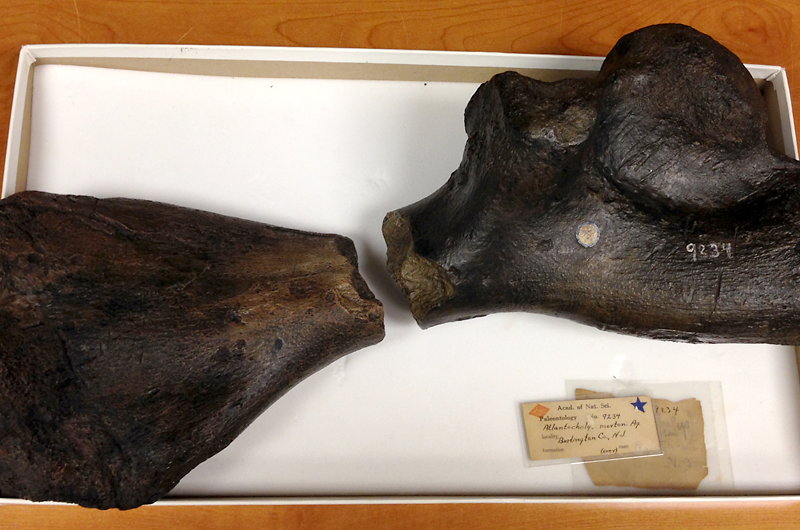
Schein and David Parris, the museum’s curator of natural history, immediately recognized the fossil as a humerus – the large upper arm bone – from a turtle, but its shaft was broken so that only the distal end, or end nearest to the elbow, remained.

Parris also thought the fossil looked extremely familiar. He joked with Schein that perhaps it was the missing half of a different large, partial turtle limb housed in the collections at the Academy of Natural Sciences of Drexel University. That bone also had a broken shaft, but only its proximal end, nearest to the shoulder, remained. The coincidence was striking.

“I didn’t think there was any chance in the world they would actually fit,” Schein said.

3-D scan of the two broken turtle limb fossils from <i>Atlantocheyls mortoni</i> shows a detailed view of their surfaces. Credit: Jesse Pruitt, Idaho Museum of Natural History

3-D scan of the two broken turtle limb fossils from Atlantocheyls mortoni shows a detailed view of their surfaces. Credit: Jesse Pruitt, Idaho Museum of Natural History

That’s because the Academy’s piece of the puzzle was much too old, according to the conventional wisdom of paleontology. Paleontologists expect that fossils found in exposed strata of rock will break down from exposure to the elements if they aren’t collected and preserved, at least within a few years– decades at the most. There was no reason to think a lost half of the same old bone would survive, intact and exposed, in a New Jersey streambed from at least the time of the old bone’s first scientific description in 1849, until Harpel found it in 2012.

The Academy’s older bone was also without a match of any kind, making a perfect match seem even more farfetched: It was originally named and described by famed 19th-century naturalist Louis Agassiz as the first, or type specimen, of its genus and species, Atlantochelys mortoni. In the intervening years, it remained the only known fossil specimen from that genus and species.

It remained so until that fateful day when Schein carried the “new” New Jersey fossil to the Academy in Philadelphia, connecting the two halves. The perfect fit between the fossils left little space for doubt. Stunned by the implications, Schein and Academy paleontology staffers Jason Poole and Ned Gilmore, who had assembled the puzzle together, called Daeschler into the room.

“Sure enough, you have two halves of the same bone, the same individual of this giant sea turtle,” said Daeschler. “One half was collected at least 162 years before the other half.”

Based on the complete turtle limb bone, paleontologists calculated the animal’s overall size to be about 10 feet from tip to tail, making it one of the largest sea turtles ever known. It may have resembled modern loggerhead turtles. In this illustration, it is depicted with the outline of a human diver to indicate scale. The turtle lived 70 to 75 million years ago. Credit: Jason Poole, Academy of Natural Sciences of Drexel University

Based on the complete turtle limb bone, paleontologists calculated the animal’s overall size to be about 10 feet from tip to tail, making it one of the largest sea turtles ever known. It may have resembled modern loggerhead turtles. In this illustration, it is depicted with the outline of a human diver to indicate scale. The turtle lived 70 to 75 million years ago. Credit: Jason Poole, Academy of Natural Sciences of Drexel University

Now, the scientists are revising their conventional wisdom to say that, sometimes, exposed fossils can survive longer than previously thought. They report their remarkable discovery in the forthcoming 2014 issue of the Proceedings of the Academy of Natural Sciences of Philadelphia. The find is also featured in the April 2014 issue of National Geographic magazine, on newsstands now.

“The astounding confluence of events that had to have happened for this to be true is just unbelievable, and probably completely unprecedented in paleontology,” said Schein.

The fully assembled A. mortoni humerus now gives the scientists more information about the massive sea turtle it came from as well. With a complete limb, they have calculated the animal’s overall size – about 10 feet from tip to tail, making it one of the largest sea turtles ever known. The species may have resembled modern loggerhead turtles, but was much larger than any sea turtle species alive today.

The scientists believe that the entire unbroken bone was originally embedded in sediment during the Cretaceous Period, 70 to 75 million years ago, when the turtle lived and died. Then those sediments eroded and the bone fractured millions of years later during the Pleistocene or Holocene, before the bone pieces became embedded in sediments and protected from further deterioration for perhaps a few thousand more years until their discovery.

– See more at: http://drexel.edu/now/archive/2014/March/Fossil-Turtle-Puzzle/

How a Web-Based Questionnaire Can Help Prevent Teen Suicide

Drexel News Blog Getting teenagers to talk about what’s bothering them isn’t always easy. But with new guidelines from the American Academy of Pediatrics recommending depression screening for adolescents (ages 11-21) during their annual physical, getting teens talking at the doctor’s office is a must. … Continue reading How a Web-Based Questionnaire Can Help Prevent Teen Suicide

11th Street Health Center to Expand With Sheller Gift to Meet the Future of Primary Health Care

Originally posted on DrexelNow.

Drexel University will begin a major expansion of its nurse-managed health center which is nationally recognized as a model of integrated care. With a new gift of $2.5 million from the Sheller Family Foundation, the center at 850 N. 11th Street will break ground for a new wing this spring, with the expanded building to be renamed the Stephen and Sandra Sheller 11th Street Family Health Services Center.

The center provides primary care integrated with behavioral health, dental care and a full range of health-promotion programs, while offering Drexel students clinical training opportunities, at the forefront of a rapidly evolving health care system. The center is located in North Philadelphia in the middle of four public housing developments, offering affordable services to urban residents and to all who seek care.

“As a therapist, I’ve worked with families who struggle with hardships that affect every aspects of their lives, including their health,” said Sandra Sheller, director, president and co-founder of the Sheller Family Foundation and a Drexel University alumna in art therapy (’04) and couple and family therapy (’05). “At 11th Street, people receive holistic, comprehensive care that recognizes their struggle and adversity cannot be separated from their health care needs. My husband and I are glad to be a contributor for a model for future health care for the entire country, one that gives students in the health care professions the best possible education and experience about health care in an underserved community.”

A National Model of Integrated Primary Care

“We want to make certain that the best possible health services are provided to a major underserved community in our region – and also make an impact beyond that community,” said Stephen Sheller, a Drexel University trustee and prominent Philadelphia attorney, co-founder of the Sheller Family Foundation. “We’ll see that impact because 11th Street is a bellwether for the country and has set the standard for the future in terms of its entire concept of care.”

The center has been recognized as an innovator and a national model of integrated primary care by organizations including the U.S. Department of Health and Human Services, the Robert Wood Johnson Foundation (RWJF) and Institute of Medicine and the American Academy of Nursing.

Patients at the 11th Street center receive primary care services from nurse practitioners with integrated behavioral health consultations available within primary care visits as needed, and as a referred service for specialized care. Primary care services are offered in partnership with the Family Practice Counseling Network.

The center also provides a broad array of other services to promote wellness – not just treat illness – including dental care, an on-site pharmacy, a fitness center, physical therapy, yoga, nutrition education and cooking classes, creative arts therapies, social work services and more – at a single location within a community. Specialized programming emphasizes even more areas, including family-centered care and substance abuse screening and treatment in primary care. The center is a hub for many activities not traditionally considered part of health care, including distribution of fresh vegetables grown on a community farm, creating public art in the Porch Light Program and even a law clinic providing legal services and advice from Drexel law students.

The center’s comprehensive patient-centered approach to health has developed over 17 years of Drexel nursing and health professions faculty working in partnership with members of the 11th Street community and numerous supportive stakeholders.

“Many health care providers are looking to examples like ours for the best ways to offer better care to more people, at lower cost – not just to keep care affordable, but to help people live well and thrive,” said Patricia Gerrity, PhD, director of the 11th Street Family Health Services, and a professor and associate dean for community programs in Drexel’s College of Nursing and Health Professions.

Facility Expansion to Meet Community Needs

“We welcomed thousands of patients for more than 32,000 clinical service visits in 2013, but due to our severe space limitations we were facing a need to limit the number of new patients we could take on,” said Gerrity. “We reached a point where we could not serve all the people who needed services. The expansion will change that.”

The new two-story expansion will provide space for more students and faculty from Drexel’s College of Nursing and Health Professions, in addition to improving and expanding current services offered to patients and the community. A groundbreaking is planned for the spring.

“Drexel has a responsibility to help build healthy communities in Philadelphia, and the 11th Street health center has been in the vanguard of that effort for more than 15 years,” said Drexel University President John A. Fry. “Steve and Sandy’s incredible vision and generous support will allow us to provide more patients with more services, while continuing to educate students at the leading edge of innovation in health care.”

Dedicated space in the new wing will be available for more primary care visits, as well as for services provided by graduate students in Drexel’s department of Couple and Family Therapy, plus new studio space for dance, music and art therapies. More space also opens the potential for developing new programming and services in response to the community’s evolving needs.

Students from Drexel’s College of Nursing and Health Professions will be better positioned to learn interdisciplinary care through practices modeled at the center, spanning areas such as nursing, nutrition sciences, physical therapy, couple and family therapy and creative arts therapies.

– See more at: http://drexel.edu/now/archive/2014/February/11th-Street-Health-Center-Expansion/

Drexel Program Participant Tianna Gaines-Turner Gets a Seat at the State of the Union

Originally posted on DrexelNow.

Tianna Gaines-Turner, a low-income mother of three children from North Philadelphia, will attend the State of the Union address as a guest of Pennsylvania Senator Bob Casey on Jan. 28, the Senator announced today. Her attendance marks a new achievement of a Drexel program raising the voices of families living in poverty to gain a place in the national conversation.

Calling for a renewed focus on jobs and the economy, working families and early childhood education, Casey announced that he had invited Gaines-Turner to attend Obama’s speech with him because policies and programs enacted in Washington have major impacts on working families.

Gaines-Turner is an expert in hunger and poverty, employment and the true struggles of working families – because she has experienced all of these challenges first-hand.

“We don’t want a hand out. We want a hand in,” Gaines-Turner said. “I hope to hear tomorrow at the State of the Union what we are going to do about hunger and poverty. I want to hear a solid plan to end them.”

Since 2008, Gaines-Turner has participated in Witnesses to Hunger, a community-based participatory research and advocacy program based at the Drexel University School of Public Health’s Center for Hunger-Free Communities and founded by associate professor and Center director Mariana Chilton, PhD. The Witnesses to Hunger program features the voices of true experts, including Gaines-Turner, by equipping caregivers of young children with digital cameras to document and describe their experiences with hunger and poverty. After beginning in Philadelphia, the program has expanded to multiple other sites, including Boston, Baltimore and Camden, N.J., with more than 80 participants in total. A new site in Sacramento, Calif., will begin recruiting soon. Through their photos and testimony, the Witnesses spark dialogue, engage and inform policy makers and inspire change.

As a Witness to Hunger, Gaines-Turner has spoken eloquently about poverty, unemployment, homelessness and struggles to afford medical care for her children in pursuit of policy changes to support better opportunities for families like hers. She has attended face-to-face meetings with representatives at the U.S. Capitol and Pennsylvania State House, written testimony submitted to the House Budget Committee, and spoken in public and through media interviews, including multiple appearances as a guest on the “Melissa Harris-Perry Show” on MSNBC.

“Her story and her struggles are emblematic of what’s happened in a lot of families,” Casey said at a press conference today. Families like Gaines-Turners’, he said, are “working hard but falling behind, working but not making the kind of progress that should result from hard work.”

“Our nation’s leaders have to be accountable to the families and communities they serve, and I know Tianna will be listening closely to keep a real perspective on what she hears at the State of the Union,” said Chilton. “I’m incredibly proud of Tianna and the women and men of Witnesses for all they have achieved, and are continuing to do, to shape the conversation around breaking the cycle of poverty and the need for programs and wages that will support low-income families and their communities.”

– See more at: http://drexel.edu/now/archive/2014/January/Witness-to-Hunger-Tianna-Gaines-Turner-SOTU/

Paperwasps in Different Castes Develop Different-Sized Sensory Brain Structures

A stained cross-section of a Leipolmeles wasp shows different brain regions. O’Donnell’s study showed that paperwasps in different castes had different-sized sensory brain regions.

Originally posted on DrexelNow.

A queen in a paperwasp colony largely stays in the dark. The worker wasps, who fly outside to seek food and building materials, see much more of the world around them. A new study indicates that the brain regions involved in sensory perception also develop differently in these castes, according to the different behavioral reliance on the senses. The study is published in Behavioral Ecology and Sociobiology.

The wasps in different castes within a colony don’t differ much genetically. The differences we see show the signature of the environment on brain development,” said Sean O’Donnell, PhD, a professor in Drexel University’s College of Arts and Sciences who led the study.

O’Donnell’s team found that the queen wasps had smaller brain regions for processing visual information than the workers in their own colonies. The pattern held across most of the 12 species of paperwasps they studied.

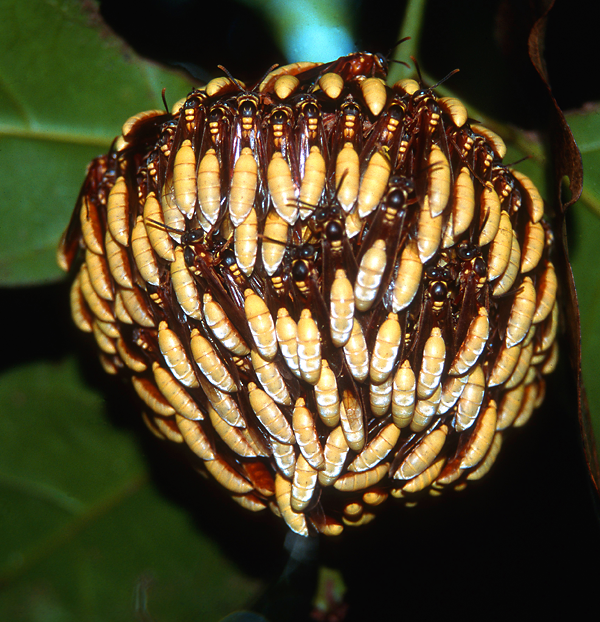
A colony of paperwasps, Apoica pallens

A colony of paperwasps, Apoica pallens

Most other research in how animals’ environments affect their nervous systems – known as neuroecology – emphasizes comparisons between the brains of different species with diverse lifestyles and behaviors, such as comparisons between nocturnal and diurnal species of birds or bats.“The strong behavioral and ecological differences between individuals within insect colonies make them powerful tools for studying how individual brain differences come about, and their functional significance,” O’Donnell said.

To test how queen-worker brain differences come about, O’Donnell’s team also compared differences in queen and worker wasps’ brain development across different wasp species they studied.

In species where adult wasps fight for the queen position, it would make sense for the caste brain differences to be less pronounced than in species where adult wasps emerge with their caste roles already established – if brain development followed a preordained program for each assigned role.

Instead, the researchers found larger differences between worker and queen wasp brains in species where adult wasps fought for dominance – a finding that suggests brain plasticity, or development in adulthood in response to environmental and behavioral needs.

O’Donnell noted that sampling juvenile wasps at multiple stages of brain development would help confirm the finding suggested by his study that only looked at adult wasp brains.

– See more at: http://drexel.edu/now/archive/2014/January/Wasp-Castes-Sensory-Brain-Structures/